Guides
What an AI agent actually does in a small business
If you run a shop, a clinic front desk, a cafe, or a small practice, you have already met a version of this problem. There is more writing than there is quiet time. Replies, offers, captions, quotes, and reminders pile up, and the work that would have taken twelve careful minutes gets postponed until it is urgent.
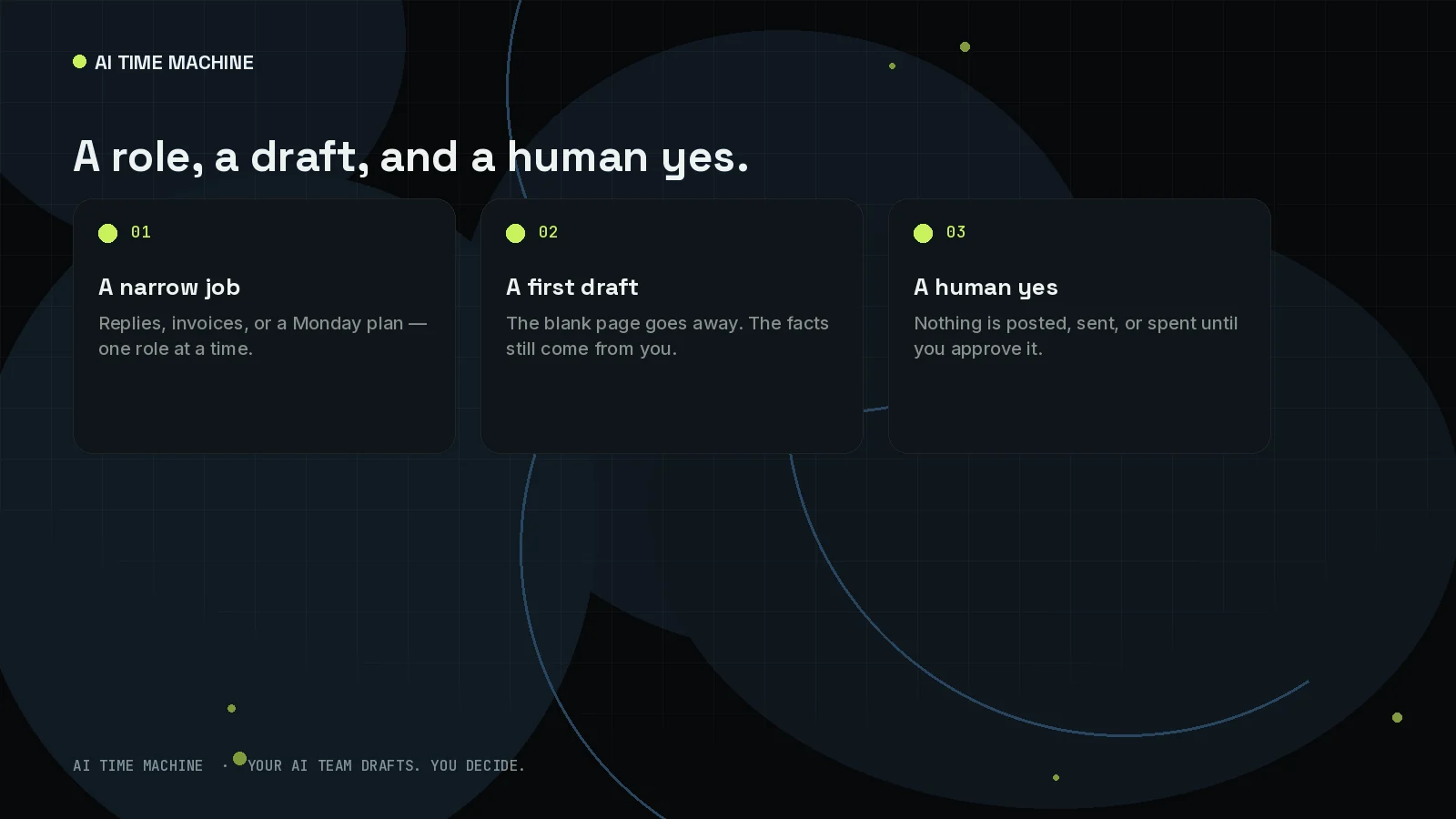
An AI agent, in this setting, is not a robot on the floor and it is not a promise that customers will arrive. It is a specialist draft-writer with a narrow job: follow-ups, or stock notes, or a Monday marketing plan. You give it the facts. It gives you something to check. You decide whether that something leaves the building.
That last sentence is the whole product idea, and it is the part many tools skip. This article explains what an agent can usefully do in a small business, where it fails, and how to keep a human yes in the middle.
A job, not a personality
It helps to think of an agent as a role, the way you already think of a person. “Customer replies” is a job. “Festival campaigns” is a job. “Invoices” is a job. The name on the card is just a way to find the role again tomorrow.
A useful agent is narrow. A narrow agent can be briefed clearly, and you can tell when it has wandered. A single “do everything” assistant often sounds confident while mixing up a refund policy with a festival offer. In a small business that mix-up is not a cute typo. It is a message a regular might read.
When you try an agent for the first time, give it one job and one set of facts. “Draft a reply to this WhatsApp, in our usual tone, without promising a delivery date we have not confirmed.” Then read the draft as if a new hire wrote it, because that is the right amount of trust.
What agents are good at
Agents are good at first drafts of work you already know how to do. That sounds modest. It is also where the time goes.
They can turn a messy note into a clean invoice line. They can take yesterday’s review and propose a calm thank-you. They can look at a short price list and write a quote a customer can actually understand. They can suggest three captions for a photo you already took. They can remind you that a GST date is coming, without filing anything in your name.
They are also useful when the work is repetitive but still needs your voice. “Where is my order?” is a daily question. The facts change. The tone should not. An agent can hold the tone and wait for you to drop in the tracking detail.
What they are not good at, today, is knowing the truth of your shop better than you do. They do not stand at the counter. They do not see the shelf. They do not hear the way a regular says your name. If a fact is missing, a careful agent should leave a gap, not invent a number, a promise, or a medical claim.
The approval is the product
A lot of software talks about automation as if the point were to remove you. For a small business, that is usually the wrong goal. The point is to remove the blank page, not the owner.
If a message can reach a customer, it should wait for a yes. If a post can appear on a public page, it should wait for a yes. If a suggestion would change ad spend or place a supplier order, it should wait for a yes. This is slower than “set and forget.” It is also how you avoid a week of cleanup after one wrong send.
In AI Time Machine, that rule is built in: drafts sit in a yes queue, and a single pause switch can quiet the whole team. Agents do not run on their own in the background yet. That is a limit, and it is also a protection. You should not have to wonder what went out while you were on the shop floor.
Briefs beat magic prompts
Owners often ask what they should “tell the AI.” The useful answer is closer to how you would brief a person on their first week.
Write the business name the way customers know it. Say what you sell, in the words you would use at the counter. Note the city or area if that matters. Add a few words you never use. If you do not give discounts on festival WhatsApp lists, say so. If you never diagnose, promise a cure, or quote a legal opinion, say so twice.
Then attach the facts for the specific job: the customer’s question, the order status you have actually checked, the price you are willing to put in writing. A good draft is mostly a rearrangement of things you already believe. A bad draft is a guess that sounds like a fact.
Keep a short repeating brief for the week — “this week we are talking about the winter menu, not the old one” — and change it when the week changes. Agents do not mind being told the same thing again. Customers mind being told the wrong thing once.
Where agents should stop
There are jobs an agent should not finish. It should not invent a medical opinion. It should not file GST. It should not pretend to be your accountant, your lawyer, or a government portal. It should not send a refund, move money, or change an ad budget because a sentence looked tidy.
It should also stop when the situation is emotional and the facts are incomplete. A complaint about a late order needs the actual time of dispatch, not a soothing paragraph. A review that mentions a staff member needs you, not a generic apology that names the wrong person.
Think of the agent as the person who prepares the tray, not the person who serves it. You still carry it to the table. That division of labour is not a marketing slogan. It is how you stay responsible for what has your name on it.
How to try this in one afternoon
You do not need a grand rollout. Pick three recurring pieces of writing: a common customer question, a weekly post, and a follow-up you always postpone. For each one, gather the real facts, ask for a draft, and edit it as you would edit a junior colleague.
Time the bit you used to dread — the staring, not the typing. Most owners find the staring was the expensive part. The edit still takes judgment, and that is the part you should keep.
If a draft is wrong, do not only rewrite the sentences. Change the brief. Add the missing fact. Note the phrase you never want to see again. The second draft is where a tool starts to feel like a team, rather than a novelty.
And if you are evaluating a product, ask one question above all others: can anything reach a customer without me? If the answer is yes, you need a very good reason to turn that on. If the answer is no, you can experiment without gambling the reputation you have already built.