Marketing
A Monday marketing plan a shop owner can actually finish
Most marketing advice assumes you have a team, a content calendar, and a quiet morning. Most shop owners have a delivery at the door and a queue at the counter. If a weekly plan cannot be finished between the first tea and the first customer, it will not be finished at all.
This is a plan you can actually complete. It is small on purpose. It uses drafts, not inspiration, and it leaves you in charge of anything that goes public.
Why small plans beat ambitious ones
A plan with twelve posts, three reels, two email sequences and a new offer every week looks professional in a workshop. In a real week it becomes a source of guilt. Guilt is not a marketing strategy. A shop that publishes two clear posts and one honest offer will look more alive than a shop that planned fourteen and posted none.
The other reason to stay small is quality of truth. Every public sentence should be something you can stand behind. That is easier when there are fewer sentences. A single festival claim you cannot honour will cost more than a missing midweek story.
Start with a rule: this week has one theme, not five. Winter stock. A slow Tuesday lunch. A repair service you already provide but rarely mention. Choose the theme on Monday, write it at the top of the page, and let everything else serve it.
The one-page Monday
Open a single page. At the top, write the theme and the dates of the week. Then fill four boxes only.
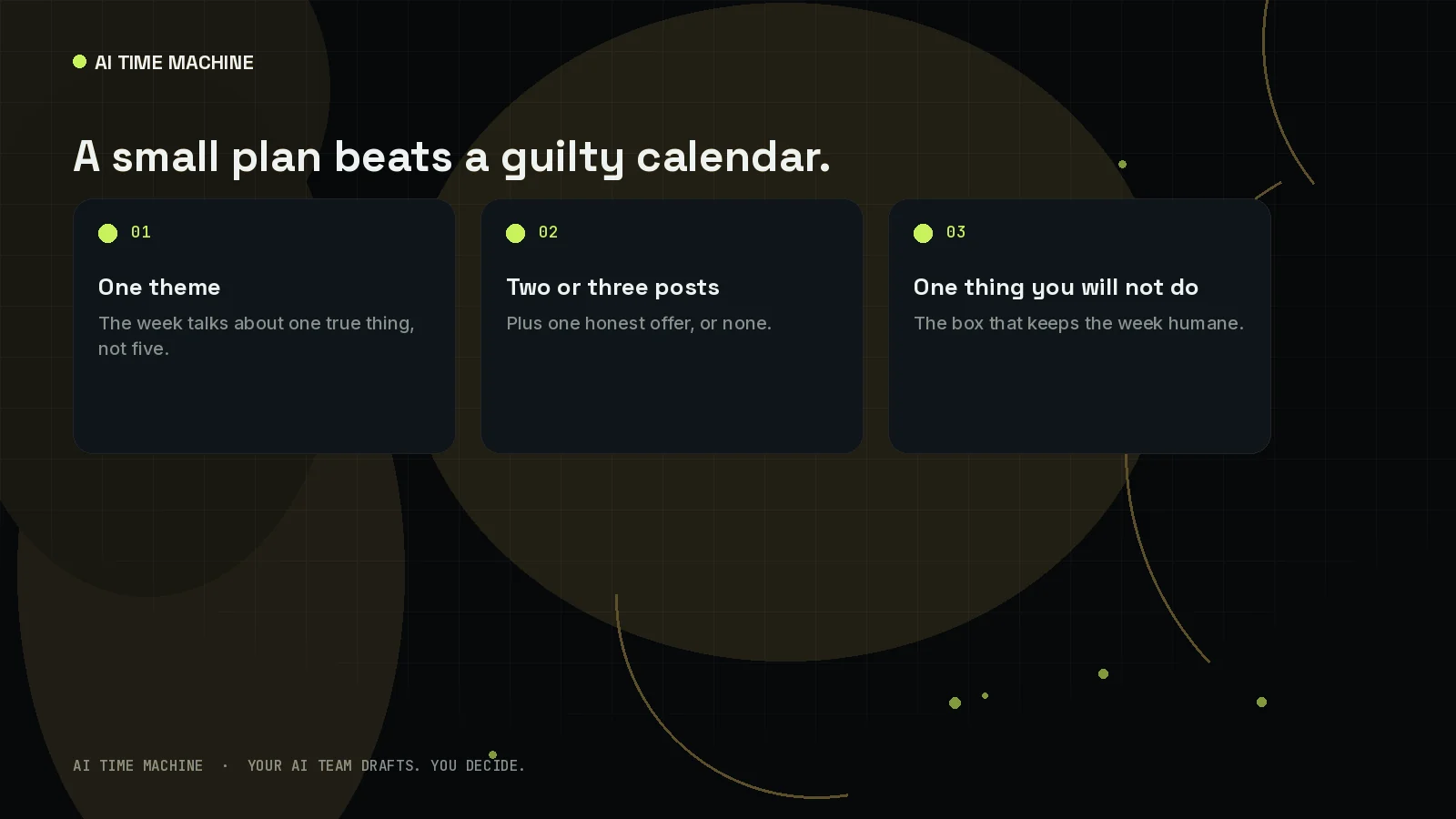
Box one: two or three posts. Not a grid for the month. Two or three. For each, write the point in one line, the photo you will actually be able to take, and the channel — Instagram, Google, or your WhatsApp status. If you cannot name the photo, the post is not ready.
Box two: one offer, or none. An offer is optional. A false offer is worse than no offer. If you do have one, write the price or the condition in the same words you will use at the counter. No hidden asterisks you will have to explain in person.
Box three: one message to people who already know you, if you have a list you are allowed to use. A short note, not a broadcast novel. It waits for your yes, like everything else.
Box four: one thing you will not do this week. This box sounds backwards and it is the one that keeps the week humane. You will not start a second theme. You will not film a reel if the shop is short-staffed. You will not invent a discount on Saturday night.
How agents help, and where they should stop
Ask an agent for a first pass at the page, not for a performance review of your brand. Give it the theme, the facts, and any dates that matter. Ask for three post ideas and one offer line. Then cut. If you use AI Time Machine, the weekly marketing plan and the festival or offer drafts are exactly this kind of work: prepared for you, sent nowhere until you approve them.
Do not ask an agent to “make it more exciting.” Excitement is how prices get rounded into promises. Ask it to make the language clearer. Ask it to sound like you. Ask it to remove adjectives you would never say out loud.
If a suggested caption needs a photo you will not have, delete the caption. If a suggested offer needs a margin you do not have, delete the offer. The plan is a filter, not a to-do list generated by someone who does not pay your rent.
Taking the pictures without a studio
Shop photography fails when it tries to be a campaign. It works when it is true. A close photograph of what you actually sell this week, in decent daylight, will outperform a designed poster with a typo in the price.
Walk the floor on Monday with your phone. Take five pictures: the thing you want to talk about, a detail, the place itself, a person only if they are happy to be shown, and one spare. You do not need all of them. You need to have them before Thursday.
Write the caption after you have the picture, not before. The caption should say what a passer-by cannot see: the price, the hours, the last day of the offer, the fact that you can alter a size or add a note in the box. Leave the poetry out unless you actually speak that way.

Midweek, and what to ignore
On Wednesday, look at the page for ten minutes. Did the first post go out? If not, send it or drop it. Do not “roll it into next week” until you have a stack of leftovers that nobody wants. A dropped post is allowed. A guilt pile is how next Monday dies.
If someone replies, answer like a person. A comment is not a second marketing asset. It is a conversation. Drafts can help; a yes is still required. If the week’s offer is confusing people, clarify it or end it. Do not add a second offer on top.
Ignore vanity errands. You do not need a new hashtag research session. You do not need to be on a platform you will not check. You do not need to reply to every trend. Your customers already know where to find you. The plan is there so they have something true to look at when they do.
A month is just four modest weeks
If you repeat this for a month, you will have eight to twelve posts, a few honest offers, and a short list of messages you actually sent. That is a marketing practice. It is not a department, and it does not need to pretend to be one.
At the end of the month, spend twenty minutes on what was useful. Which post did people ask about in person? Which offer was awkward to honour? Which photograph looked like your shop? Keep those. Throw the rest away without a ceremony.
The test of a Monday plan is not whether it would impress another marketer. The test is whether, by Friday, you did a small number of true things in public, and whether you can do it again next Monday without dreading the page.
A worked example, without a fictional success story
Imagine a small stationery and gift shop in a neighbourhood market. The theme for the week is exam season: notebooks, simple pouches, and a refill service the shop already offers but rarely mentions. On Monday the owner takes photographs of a neat stack, a pouch in daylight, and the refill corner. The plan asks for two posts and one short note to past customers, with no new discount.
The first post is the stack and a clear price for a popular notebook. The second is the refill service, with the days it is available and a sentence that says you do not need to buy the original from the shop. The customer note, if it goes out at all, is two lines and a photograph, approved on Tuesday, not written at midnight on Friday.
Nothing about this is clever. That is why it works as a plan. It uses stock that exists, a service that exists, and language the owner would use if someone asked in person. An agent can draft the captions and the note. The owner still checks the prices, the days, and the tone. If the refill corner looks messy in the photograph, the post waits until the corner is tidy. The week stays honest, and Monday of the following week does not start with leftover promises.