Support
Handling returns, reviews and complaints with a calm first draft

Some of the most important writing in a business is done on a day you would rather not write at all. A return that is going to be awkward. A review that stings. A complaint that arrives in capital letters. The first sentence you type in that mood is rarely the sentence you should send.
A calm first draft is not a way to hide. It is a way to give yourself a starting point that is fair, so you can then add the facts and the decision only you can make. This article is about that process, and about the lines a tool should never cross on its own.
Start with the file, not with the keyboard
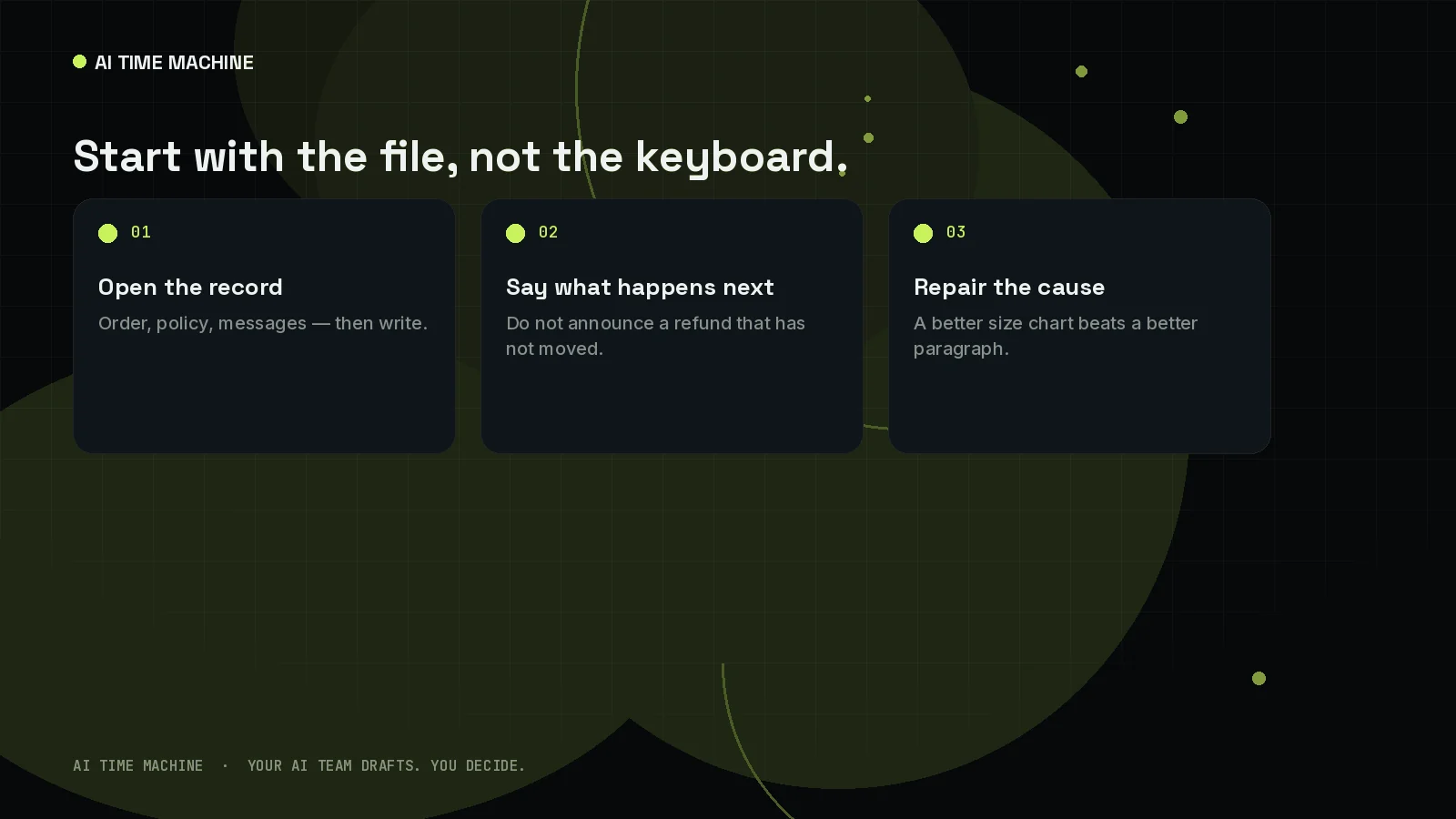
Before any draft, open the record. The order, the date, the payment, the photographs if you have them, the policy you actually published, the messages so far. If you cannot find the record, say that you are looking, and do not describe a decision you have not taken.
Policies should be short enough to use when you are tired. A returns window, a condition (unused, tags on, sealed, perishable), and the path money takes if you agree to a refund. If you do not have a policy, you will invent one in the reply, which is how two customers get two different answers and both of them tell other people.
Write the policy in ordinary language and keep it where staff can see it. Then follow it, including when it would be easier to make a special exception you will later regret, or to refuse something you have already promised in writing.
Returns and refunds, described honestly
A returns reply has three jobs: acknowledge the request, explain what happens next, and not move money in a sentence before it has moved in the world. “I have seen this and I will confirm by this evening whether we can take it back under our seven-day window” is a complete message. “The refund has been issued” is only a complete message if it has.
Do not hide a no in long language. If the item is outside the window, or opened when it needed to stay sealed, say so plainly and, if you can, offer what you can offer — a repair, a credit, a different size — without pretending it is the thing they asked for.
Agents can sort a request into a draft and explain a refund in simple words. They should not issue a refund, change an order, or tell a customer that money is on the way. You remain the person who looks at the account and then approves the message. If your tools have a yes queue, use it here even when you are in a hurry, especially when you are in a hurry.
Reviews are for the next stranger as well
A public review is a conversation with the writer and a sign for everyone else. Thank a kind review in a way that sounds like you, not like a template that could be stamped on a thousand shops. If you can mention the actual thing they bought, even better, as long as you do not expose something private.
For a sharp review, resist the theatre of a long defence. Acknowledge the specific problem, say what you have done or will do, and invite the person to a private channel for anything about money or personal details. Do not demand that they change the review as a condition of help. Do not argue about whether they are a “real customer” in public, even if you have doubts; deal with doubts quietly.
If the review is wrong on a fact you can show — you were closed that day, you do not offer that service — you may say so, calmly, once. Then stop. A long thread under a review rarely looks like winning.
Complaints, including the ones that name a person
When someone is upset, a first draft should slow you down. Let an agent propose a calm opening if that helps you not to reply in kind. Then rewrite anything that sounds legal, icy, or sarcastic. Add the fact. Add the next step. Add an apology when an apology is due, and do not add one so automatic that it means nothing.
If a member of staff is named, take the conversation off the public page and off the fast queue. Speak to the staff member. Look at what you can know. Do not announce a punishment in a customer thread. Do not throw a member of staff under a bus to make a paragraph look decisive, and do not dismiss a customer because you like the staff member. You are trying to be fair, which is slower than being loyal to a side.
Some complaints are not really about the item in the sentence. They are about a wait, a tone at the counter, a feeling of being disbelieved. A good reply can name that without pretending you can undo the afternoon. “I am sorry you were made to wait and that this felt dismissive. Here is what I can do now.” Then do that thing.

Words that should never appear just because they sound official
Beware of phrases a tool has learned from airlines and banks. “As per our policy.” “We regret you feel that way.” “Your feedback is important to us.” “Please be advised.” If you would not say it, do not send it. Official language is often a way to hide a simple no, or a simple yes, and customers can tell.
Also beware of promises a draft might add for polish: a specific delivery time, a guaranteed outcome, a medical or legal opinion, a discount that does not exist. Cut them. If you want to give something extra, decide it yourself and write it in your own words.
If the matter is heading toward a formal dispute, a chargeback, or a legal threat, stop relying on a general assistant and speak to someone who can advise you. A calm draft can still help you collect the timeline. It cannot be your lawyer.
After the message, change the thing that caused it if you can
The writing is only half of the work. If the same return appears because the size chart is wrong, fix the size chart. If reviews mention a long wait on one afternoon of the week, look at the staffing. If complaints mention a confusing offer, end the offer or rewrite it.
A tool can help you notice a pattern if you keep notes. It cannot fix the pattern. The reputation of a small business is the sum of these repairs, plus the tone of the replies in the meantime. A calm first draft is a way to protect the tone. The repairs are how you need fewer such drafts next year.
None of this requires a large support department. It requires a policy you actually use, a record you can find, a yes before money is mentioned as already moved, and a person who is willing to read one difficult message twice. That is ordinary work. It is also the work people remember longer than a caption.
A first draft that you then edit is still your writing. The tool saved you from the worst first sentence. You still have to send a sentence you can live with tomorrow.