Pricing
One-time software versus a monthly AI subscription: how to think about cost
The price of a tool is easy to misread, because there are usually two prices. There is the price of the software that organises the work. And there is the price of the intelligence that writes the draft, which often lives on someone else’s meter. If you mix them up, a cheap month can become an expensive year, and a one-time fee can look complete when it is not.
This article is a way to think about that split, using ordinary language and no theatre about what a business “must” spend. It also explains how AI Time Machine is priced, because the honest version of that story includes a second bill you should expect.
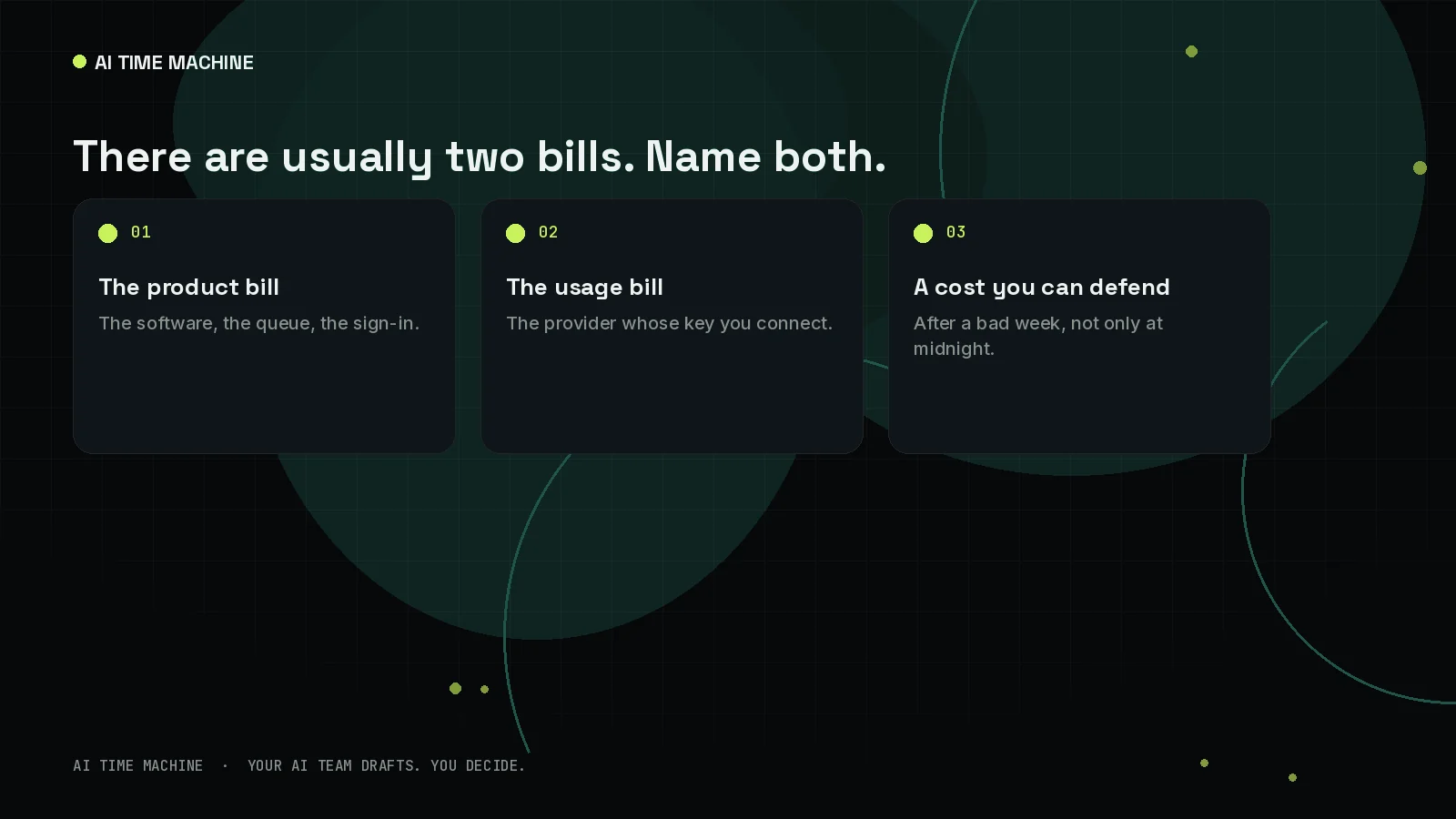
Name the two bills
Bill one is the product: the place where drafts sit, the team of roles, the sign-in, the yes queue, the settings. Bill two is the AI provider: Anthropic, OpenAI, xAI, or whoever issues the key you connect. Bill two goes up when you use it more, and it follows that company’s prices and terms, which they can change.
A monthly “all-in” subscription may hide bill two inside a single number, or it may include a small allowance and then surprise you. A one-time product with a bring-your-own key, like AI Time Machine, shows bill one clearly — ₹1,999 once, with no monthly fee for that purchase — and leaves bill two in your hands. Neither model is automatically kinder. They are simply different, and you should know which one you are in.
Write the two bills on a scrap of paper when you compare tools. If a salesperson will not tell you which bill you are looking at, that is already information.
What a one-time fee is, and what it is not
A one-time fee is a purchase. You pay, you receive access, and you are not rented the same product again every month for that purchase. That is easier to budget, and it is easier to explain to a partner or a spouse. It is also easier to walk away from a bad habit of stacking subscriptions you forgot.
It is not a promise that the product will never change, or that hosting will be free for you forever in every possible future, or that the AI work is included. It is not a promise of a result in the business. And it is not cheaper than a monthly tool in every case: if you would only have used a monthly tool for three weeks, the month might have been the smaller number.
For AI Time Machine, the ₹1,999 is the product and the access. After you pay, we email a sign-in code. You then connect your own key if you want agents to draft. If you never connect a key, you will not be doing the AI work, and you should know that before you buy. Visitors outside India may see a dollar figure on the offer page; the payment is still taken in rupees through Cashfree, and the charge may show as Rizwiz Enterprises.
Monthly tools, used with a clear head
A monthly subscription can be the right shape when you want to try something for a short time, or when the vendor is including a genuine usage allowance you understand. It can also be the right shape when the product is being improved quickly and you want to stay current without thinking about it.
The risks are familiar. The price rises after a promotional year. The plan you chose is retired. The allowance is too small for a busy festival week and the overage is hard to see until the bill arrives. Several small monthly tools, each “only” a few hundred rupees, become a silent salary.
If you use a monthly tool, put a reminder in your calendar a week before the renewal. Read the last invoice. Cancel anything you did not open. This is dull advice and it saves more money than most pricing pages will admit.
How to estimate the usage bill without pretending to be an analyst
You will not get a perfect forecast. You can get a range. Look at how the provider charges — usually by the amount of text you send and receive — and then be honest about your week. A few captions and replies are a different week from hundreds of long documents.
Start small. Use the key on a handful of real jobs and then look at the provider’s own usage page. That page is the truth, not a blog post’s example numbers, including this one. We will not invent a typical rupee figure for your shop, because we do not know your volume, your model, or next month’s prices.
If the usage surprises you, change the habit before you change the product. Shorter briefs, less pasting of entire histories, and fewer “make ten versions” requests will usually do more than shopping for a slightly different plan. If you do not need a heavy model for a short reply, do not use one.
Other costs that do not appear as a line item
Time is a cost. A tool that sends the wrong message will take an afternoon to unwind. A tool that requires a week of setup will cost more than its fee if you never finish the setup. A tool that you do not trust, and therefore do not use, is a sunk cost whether it was monthly or one-time.
Staff time is a cost. If only you can operate the software, every draft runs through the same bottleneck. If anyone can send without a yes, the cost may arrive as a customer problem. A yes queue has a time cost, and it is usually cheaper than the other kind.
Data and lock-in are costs. If your invoices, customer lists, and brand voice live only inside a tool you rent, leaving is hard. Prefer products that let you take your facts with you, and prefer a way of working that still makes sense on a paper list if you have to.
A simple way to choose
Ignore the adjectives on the pricing page for a moment. Write down the jobs you actually want help with this quarter — replies, a Monday plan, invoices, follow-ups. Write down the two bills, as far as you can see them. Write down what happens if you stop paying, and what happens if the tool is wrong in public.
If you want a bounded purchase and you are willing to run your own AI key, a one-time product with an approval queue is a coherent shape. If you want a short experiment and a single blended invoice, a monthly tool with a clear allowance may be a coherent shape. If you want a result guaranteed, neither shape will provide it, and anyone who says otherwise is selling a feeling.
Then choose, use the tool on real work for a fortnight, and look at the bills and the drafts with a cool head. The right cost is the one you understand, can afford, and can defend after a bad week, not the one that looked smallest in a comparison table at midnight.