Finance
Invoices, payment reminders and GST dates: what AI can draft, and what it cannot file
Money is where cheerful automation should become quiet. An invoice with the wrong amount, a reminder sent to someone who has paid, or a pretence that a tool can file your GST — these are not small errors. They cost trust, and sometimes they cost money.
Used carefully, though, writing help is useful here too. Most of the delay in a small business is not accounting theory. It is the blank page: the invoice not sent, the reminder not written, the GST date remembered two days late. This article draws a boundary. On one side, drafts and reminders. On the other, work that still belongs to you and, when needed, to a qualified accountant.
Invoice drafts are paperwork, not a performance
A good invoice is boring. It names you, it names the customer, it names what was sold, the date, the amount, and how to pay. If you have a GSTIN and must show tax, it shows tax correctly. If you do not, it does not invent a tax line to look official.
An agent can turn your notes into that boring page. “Ramesh, 12 tins, 9 November, the rate we agreed last month.” The draft should not fill a hole with a guess. If the rate is missing, the draft should ask you. If the name is incomplete, it should leave a gap. You approve the invoice the way you approve a message: only when every figure is one you would defend.
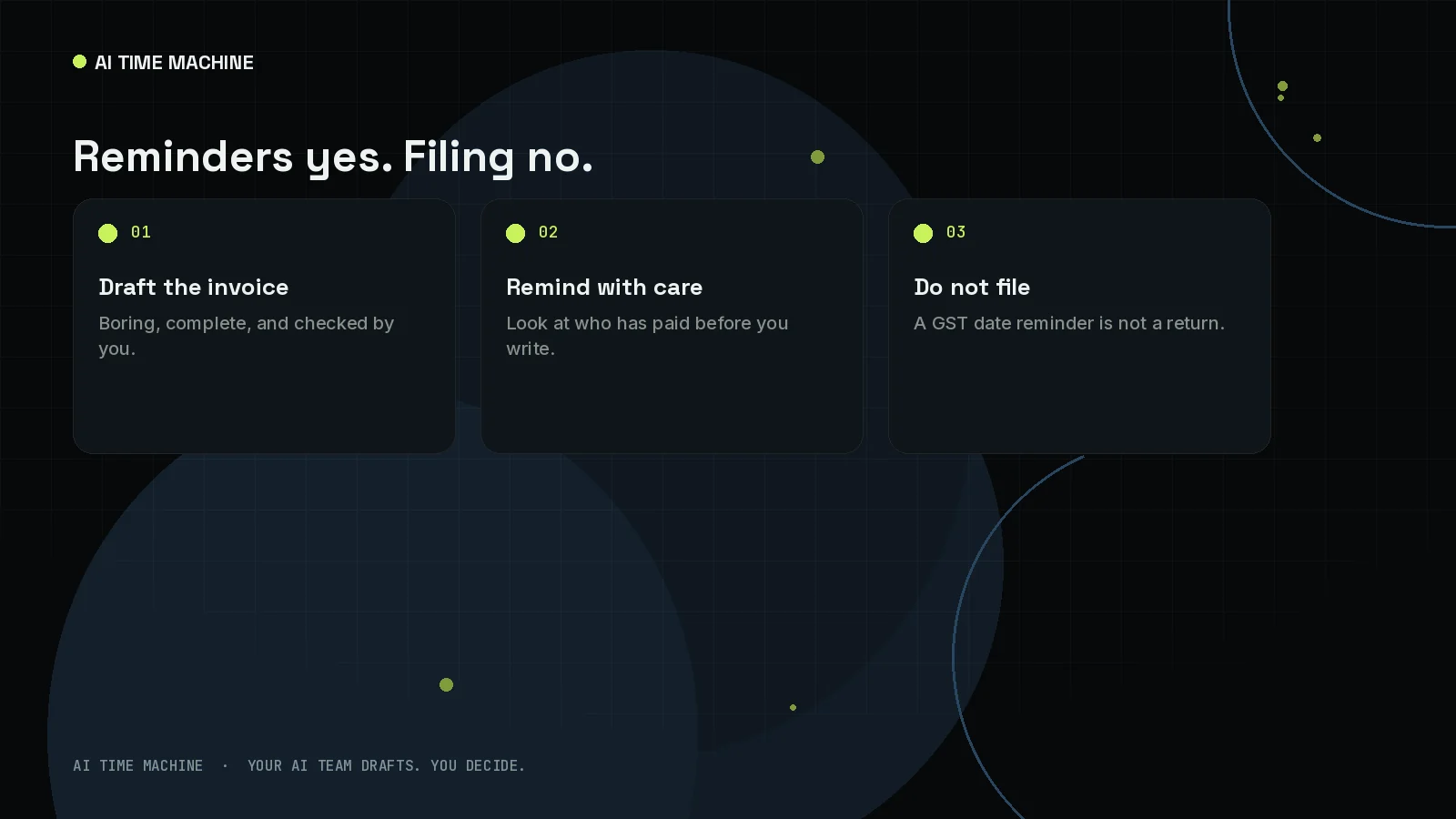
Do not let a tool decorate an invoice with slogans. Do not let it offer a late fee you do not actually charge, or a discount you did not agree. Send it only when you have said yes. In AI Time Machine, the invoice agent is written this way: it drafts, it can keep a list of who has paid, and it sends nothing until you approve.
Payment reminders that you would accept
A reminder is a sensitive message. The person may have paid already. They may be in a difficult month. They may have never received the first invoice. Your first job is to check, not to write.
Once you have checked, a polite reminder is short and factual. It names the invoice, the date, the amount, and the payment method. It does not threaten. It does not joke. It does not shame. It does not invent a legal consequence you will not pursue.
A reasonable sequence, for many small businesses, is the invoice, a short check-in after your usual terms, and one clearer note after that. Then you decide, as a human, whether to call, to wait, or to stop work. A tool should not run that sequence on its own. It should draft the next note when you ask, and wait.
If someone has paid, thank them and close the thread. A reminder that arrives after the money has landed is an insult even when it is an honest mistake. Keep the “who has paid” list in one place and look at it before every yes.
Numbers you may summarise, and numbers you may not invent
Owners often want a picture of the week: what came in, what went out, what is still owed. A short summary in plain language can help, if every figure comes from you or from a record you trust. “Does not invent figures” should be a hard rule. If a number is missing, the summary should say it is missing.
Do not ask a general AI tool to produce a P&L from memory, or to estimate your tax from a chat. Do not paste your entire bank password anywhere, ever. If you paste transactions, paste only what you are willing to send to the AI provider whose key you use, and remember that this is not a substitute for books.
Expense notes are a safer, smaller job. A messy line in a diary — “auto to Okhla, 450, samples” — can become a clean expense line you then check. That is clerical help. It is not bookkeeping sign-off.
GST dates are reminders, not a filing product
A reminder before a GST date is useful in the way a calendar is useful. It is a tap on the shoulder. It is not a claim that the tool has prepared your return, computed your liability, or submitted anything to the portal.
You, or your accountant, still file. You still own the figures. If you are not sure whether a date applies to you, ask a professional, not a caption generator. A product that is honest will say this in plain words, the way AI Time Machine does: the GST agent reminds you, and it does not file.
The same is true of other official deadlines. A reminder is a kindness. A generated form is a risk. Do not let the tone of a confident paragraph talk you into a filing you have not checked.
What belongs with an accountant or a lawyer
If you are choosing a registration, changing the way you charge tax, handling a notice, writing off a large unpaid bill, or entering a contract with serious money attached, stop drafting and call a person whose job it is to be right about this.
AI can still help you prepare for that conversation: a list of questions, a timeline of invoices, a plain-language summary of what happened. That preparation can save an expensive hour. It cannot replace the hour.
Be wary of any product, including ours, if you ever catch it sounding like formal tax advice. It should not. If a draft crosses that line, do not send it to a customer and do not follow it yourself. Bring it back to ordinary language, or delete it.
A monthly rhythm that stays boring on purpose
Give money work a repeating slot, the same way this article gave marketing a Monday. Once a week, send the invoices that are actually due, after a check. Once a week, look at who has not paid and decide which reminders are fair. Once a month, sit with your accountant or your own books, not with a chat window, and look at the real numbers.
Let tools take the blank page out of the weekly steps. Do not let them take the judgement out of the monthly one. The complement of a careful AI team is not a smaller sense of responsibility. It is a slightly clearer desk, and the same standard you already have when a customer is standing in front of you with a bill in their hand.
Records you should still keep yourself
Even when drafts are coming from a tool, keep your own copy of what was agreed. A chat thread is not always easy to find six months later. Save the approved invoice, the payment reference, and a note of any special term you offered. If you use email, send yourself a copy. If you work mainly on WhatsApp, download or file the important pages on a regular day, not only when there is a dispute.
This sounds like extra work, and it is less work than reconstructing a number during an argument. It is also how you stay independent of any one product. Tools change. Your responsibility for a tax figure or a paid invoice does not.
If a customer asks for a formal GST invoice and you are registered to issue one, do not send a pretty unofficial bill and hope. If you are not registered, do not let a template put a GST line on the page to look bigger. The design of a document is not a substitute for its legal meaning.