Getting started
How to brief an AI team on day one (and how to pause it when you need to)
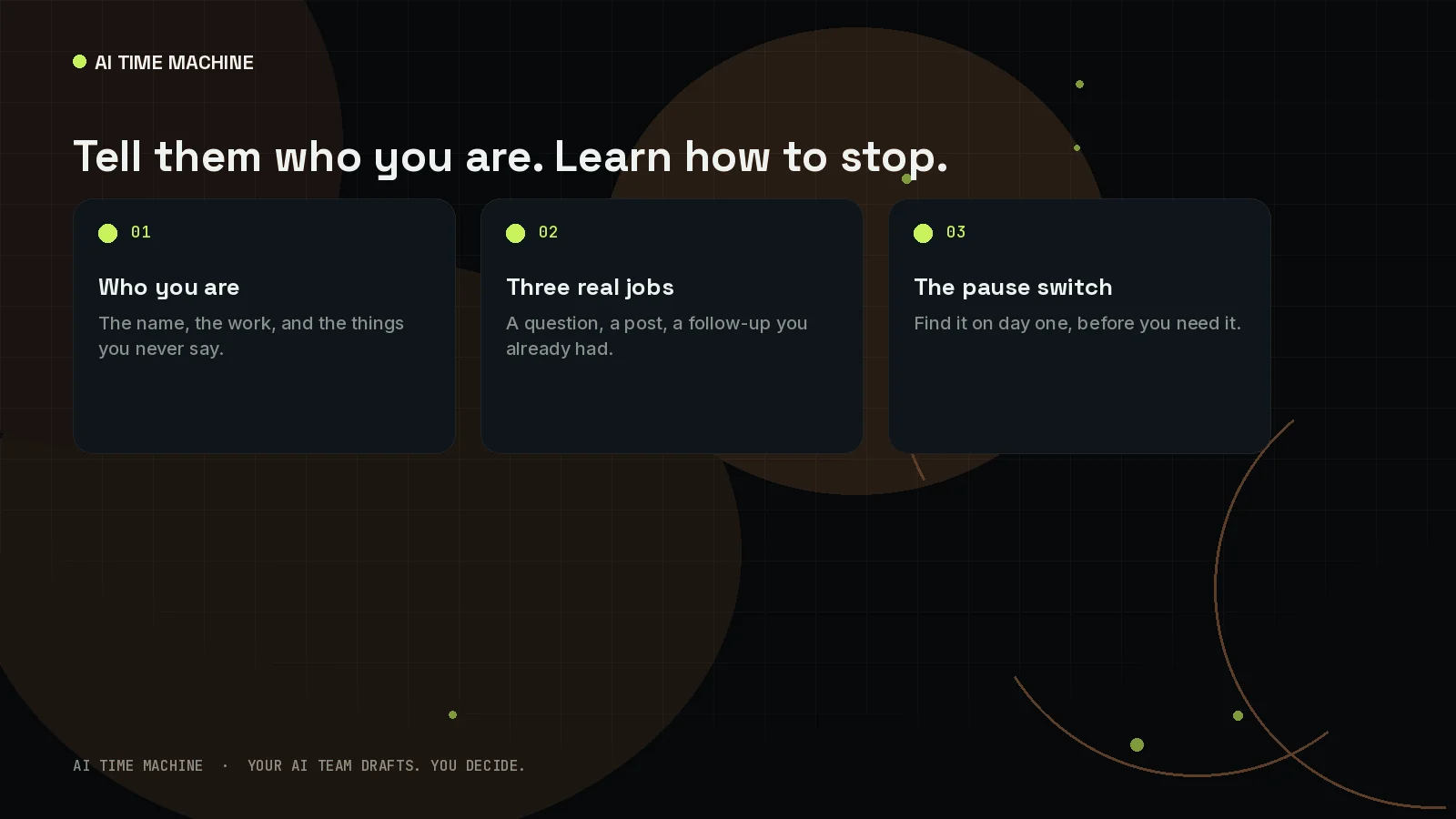
The first day with a new tool often disappears into settings. You click, you promise yourself you will finish later, and later is a month. A better first day is short and concrete: you tell the team who you are, you set a few rules, you try two or three real jobs, and you learn where the pause switch is before you need it.
This is a day-one brief for an AI team in a small business. It assumes the team can draft, and that nothing should go out until you say yes. That is how AI Time Machine is built, and it is a sensible way to treat any similar product.
Write the business as a customer already knows it
Start with the name on the fascia, not the legal name, unless they are the same. Say the city or the area if it matters. Say what you sell, in the words people use when they walk in. “We sell school notebooks, gift wrapping, and photocopying,” is better than “we are a one-stop stationery solutions provider.”
Add a few facts that prevent errors: hours, the channels you actually monitor, whether you deliver, whether you close on a particular day, prices you are willing to put in writing, and the things you do not do. If you are a clinic front desk, say clearly that the tool must not invent medical advice. If you handle money, say that it must not invent figures or talk about a refund as if it had already been paid.
This profile is not a slogan exercise. It is the difference between a draft that sounds like your shop and a draft that sounds like a stranger. You can change it later. You cannot skip it and then complain that the team does not know you.
Set rules before you ask for cleverness
Write down what must never go out without a special look: refunds, complaints, anything that names a staff member, any price change, any medical, legal, or tax claim, any festival offer, any message to a journalist. Write down the tone: the languages you use, the words you never use, whether you want short WhatsApp lines or fuller emails.
If more than one person will use the product, write down who may approve what. A helper may be allowed to approve a hours reply when the sign on the door agrees. Only you may approve a refund. Informal arrangements fail on busy days.
If the product has a yes queue, treat it as the default, not as an optional extra. If it has a pause switch, find it on day one and use it once, just so you know how it feels. In AI Time Machine, one switch pauses the whole team, and agents do not run on their own in the background yet. That is a limit you should understand on the first day, not on the first bad day.
Connect the key, and understand the second bill
If AI features run on a key you already have — Claude, ChatGPT, or Grok — connect it in a calm moment and use the test action if there is one. Store it only in the place the product provides. Do not paste it into a chat, an email, or a shared note.
Remember that this key has its own bill, separate from the software you purchased. Look at the provider’s usage page after the first few jobs, not after the first festival week. If something fails, check the provider’s credit and the error, and do not send the full key to support.
If you are not ready to connect a key, do not pretend the team will draft anyway. Finish the profile, learn the queue, and come back to the key when you are ready. A half-connected setup is how first days turn into abandoned logins.
Pick three real jobs, not a grand tour
Choose three pieces of work that were going to exist anyway: a customer question waiting on your phone, a post you already meant to write, a follow-up you have been postponing, or an invoice you need to send. Gather the facts. Ask for a draft. Edit it. Approve it or leave it.
The point is not to “try every agent.” The point is to see the path from brief to yes on work you understand. If a draft is wrong, correct the brief as well as the sentences. Add the missing fact. Add the phrase you never want. The second attempt is the one that tells you whether the team will be useful.
Resist the urge to paste your entire life into the first chat. Short, true context beats a pile of old forwards. You can always add a fact. It is harder to pull a fact back after it has been sent to a provider.
Learn the stop conditions as carefully as the start ones
Before you finish the day, practice a stop. Pause the team. Confirm that nothing in the queue can send itself. Decide what you will do if you go on leave, or if a crisis lands — a death in the family, a sudden illness, a day when the shop is simply too full. The answer should be: pause, and let people wait for a human message, or leave a short public note that you will reply later.
Also decide what “later” means for drafts that pile up. A queue you are afraid to open is a queue that will be approved too fast. Better to delete or postpone anything that has gone stale than to send a festival greeting in the wrong week.
If you ever feel that a tool is talking to customers without you, treat that as an incident, not as a feature. Turn it off, read what went out, and write to the people who received something they should not have received. Then write to the vendor. You should not have to negotiate for a basic safety control.
Close the first day with a small ritual
Write four lines in a place you will see tomorrow: the pace you will try this week, the three jobs you already did, the rule that felt most important, and a reminder to look at the usage page. Then stop. Do not spend the evening tweaking settings. A tool becomes part of a business by doing tomorrow’s ordinary work, not by being perfectly configured tonight.
On the second day, do one real job before you open any other software errand. On the third, invite a colleague, if you have one, to watch an approval so the yes is not a mystery. After a week, look back at what you actually used, and hide or ignore the rest of the roster until you need it. Fifty-five roles are less useful than three you trust.
A first day is successful if, at the end of it, the team knows who you are, you know how to stop it, and one true piece of work is better or faster than it would have been without the help. That is enough. The rest can be learned in the same way you learned the rest of the shop: by doing the next ordinary thing, carefully, and by keeping the last word.