Marketing
Festival campaigns without the last-minute scramble
Indian business life has a calendar that marketing software often treats as an afterthought. Diwali, Eid, Christmas, Pongal, Onam, Durga Puja, Republic Day, back-to-school, wedding season — the dates are known, and yet the work still begins the night before. The lights are up, the stock is half unpacked, and someone is writing a caption with a price they have not checked.
This is a way to prepare festival work early, without pretending you have a campaign team, and without letting a draft go public before you mean it.
Put the dates on one page before you need them
Once or twice a year, sit down with a calendar and write the festivals and seasons that actually affect your shop. Not every public holiday. The ones that change what people buy from you, or when they walk in, or when you will be closed.
For each, write four facts only: the date (or the likely window), whether you will be open, whether you will have a genuine offer, and what you will probably sell more of. If you close, that is also a public fact. People should not arrive at a locked door because a post wished them a happy evening and forgot the hours.
Keep the page somewhere you will see it in ordinary weeks, not in a folder named “later.” Later is how last-minute nights are born. A paper sheet by the till is more useful than a beautiful document you never open.
Honest offers, decided while you can still do the arithmetic
Festival discounts are easy to announce and hard to honour when you are tired. Decide the offer in a quiet week, with the margin in front of you, not on the festival eve because a competitor posted first.
Write the offer in the same words you will use at the counter and in a caption. Include the end date, the exclusions, and whether it applies in person, online, or both. If it is only for a few items, name them. If you cannot afford an offer, do not invent one. A festival greeting plus a photograph of what you actually have is a complete campaign for a small shop.
Be careful with urgency. “Today only” should mean today only. “While stocks last” should mean you have counted the stock. A tool will happily write scarcity for you. You should not approve it unless it is true.
Photographs and words, prepared as a set
The night-before scramble is often a photography problem dressed up as a writing problem. You cannot write a caption for a window display you have not finished. So set a day, a week or more ahead, to take the pictures: the product, the wrapping, the lights, the staff if they agree, the closed-sign you will actually hang if you will close.
Then ask for draft captions, a short WhatsApp note for people who already know you, and a line for your Google listing. Give the agent the facts from your one-page calendar and the offer you have already decided. Ask it not to add fireworks language you would not say yourself.
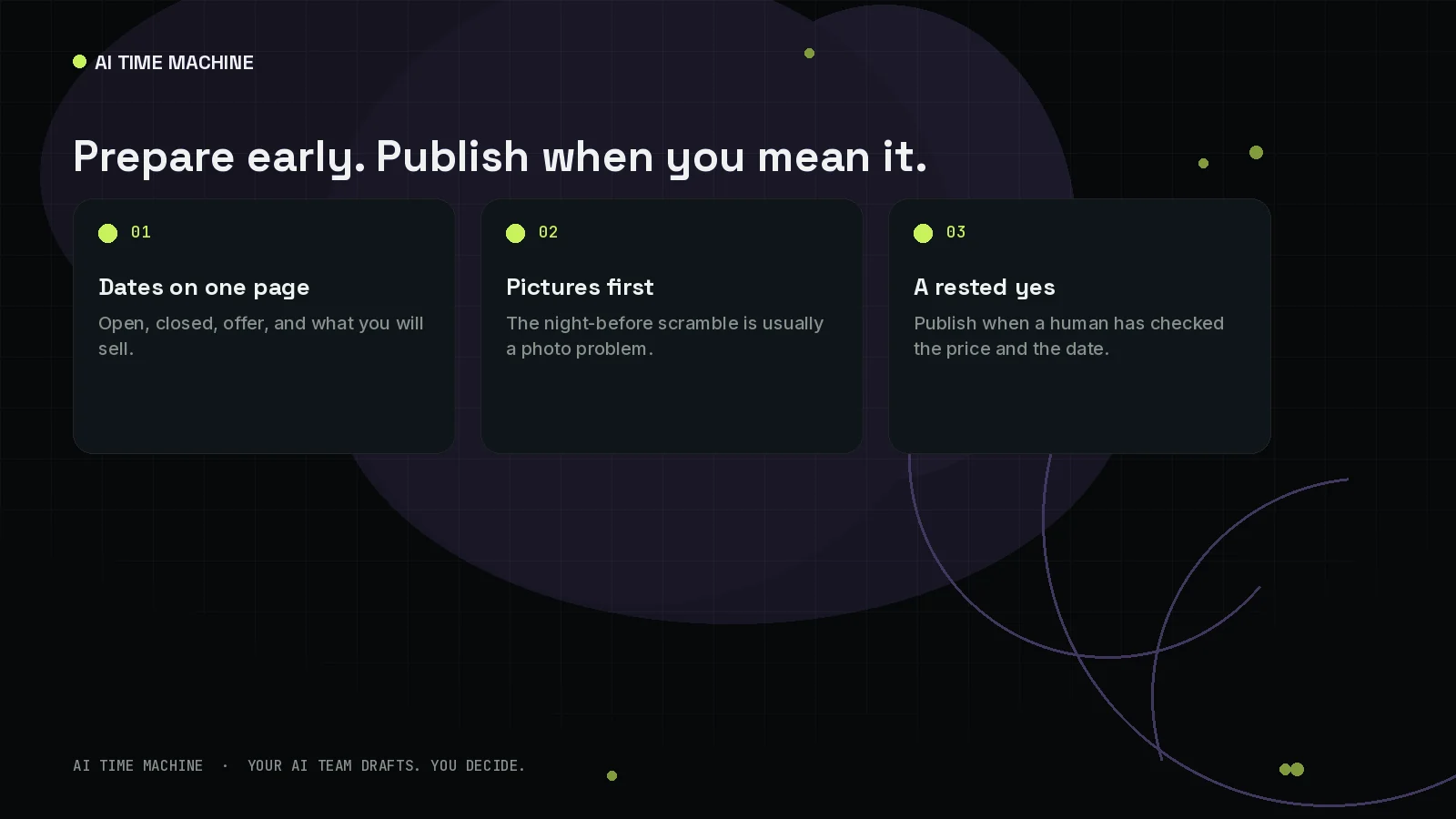
In AI Time Machine, festival campaign and festival post agents exist for this kind of preparation. They can get drafts ready early. They still wait for your yes. That is the correct order: prepare, look, then publish, with enough time that a typo in the date can be caught by a human who is not also hanging lights.
A simple run-of-show for the week itself
Two or three days before, schedule your own time, not only the posts. When will the first greeting go out. When will the offer, if any, start and stop. Who is minding the inbox while you are on the floor. Who is allowed to approve a routine reply, and who must check a complaint.
Write a short list of replies you expect: are you open, do you deliver, is the offer on this item, can I reserve one. Put the true answers next to them. During the festival, you will not want to invent policy in a hurry.
On the day, do less than you planned if the floor is busy. A missed story is nothing. A wrong price in a story is a queue of arguments. If you have to choose, choose the shop in front of you. The internet will still be there in the evening, and a late true post is better than an early false one.
After the festival, while you still remember
The week after is when next year’s work gets cheaper. Write down what sold, what you ran out of, which caption felt embarrassing, which photograph looked like your shop, and which message people asked you to repeat in person. If an offer was awkward to honour, retire it in writing so you do not repeat it out of habit.
Do not invent a success story for yourself. If the week was simply busy and human, that is enough to record. If something failed — a late dispatch, a confused offer, a day you should have shown as closed — record that too. Agents can hold a brief; they cannot hold a memory you never wrote down.
Then put a reminder in the ordinary calendar, a few weeks before the next important date, to open the page again. Preparation is a loop, not a heroic night.
What not to outsource
Do not outsource the decision to be open or closed. Do not outsource the arithmetic of an offer. Do not outsource a religious or cultural greeting you do not understand well enough to stand behind. A generic “happy festivities” is safer than a specific wish with the wrong date or the wrong community in a city as mixed as ours.
Do not outsource delivery promises you have not checked with the courier or your own hands. Festivals strain logistics. A draft that says “arrives tomorrow” during a peak week is a future complaint.
You can outsource the blank page. You can ask for three versions of a greeting and pick one. You can ask for a shorter WhatsApp line and a slightly fuller Google post. That is useful work. The yes, the hours, the price, and the respect in the wording stay with you. Start early enough that the yes is given by a rested person. That, more than any caption trick, is how a festival week stays calm.
A note on paid ads during festivals
If you run ads at all, treat them as a separate decision, not as a switch that flips when a caption is ready. Budgets go further than you expect in a noisy week, and they also disappear faster than you expect. Decide a ceiling in a quiet moment. Do not approve a “boost” because a draft made it sound casual.
Check the landing fact the ad will send people to: the hours, the offer, the phone number, the item in the photograph. Festival ads that lead to an outdated page, or to a “see website” that does not mention the offer, waste money and patience together.
If you do not run ads, you are not behind. A accurate listing, a true offer, and a shop that is ready for the people who already planned to come will carry a small business through most festivals. Start the writing early enough that the ads question, if it arises, is asked by a calm person with a number in mind, not by a tired one with a phone in their hand in the dark.