Support
How to answer customers faster without sounding like a bot

Customers do not want a novel. They want a true answer, in a human voice, soon enough that they do not feel ignored. That combination is harder than it looks. Fast replies go sharp. Careful replies go late. Templates go stiff. The work is to be quicker without becoming a machine.
This article is a method you can use in a shop, a cafe, a clinic front desk, or an online catalogue. It assumes you will remain the last person to approve anything that leaves.
What people are actually asking
Most incoming messages fall into a short list. Is this available. What does it cost. Where is my order. Can I return it. What are your hours. Can I book. Something went wrong.
Write that list down. Next to each item, write where the truth lives: the shelf, the price list, the courier page, the returns policy, the door sign, the diary. The delay in most businesses is not typing. It is hunting for the fact.
If a question is not on the list, it is either a new regular question — add it — or a special case. Special cases should not be answered with a template, however well written. They should be answered by a person who has read the whole thread.
Tone is a set of decisions, not a vibe
“Sound like us” is vague until you make it specific. Decide a few things in writing. Do you use the customer’s name. Do you say please and thank you every time, or only when it is natural. Do you use Hindi, English, or a mix, and in which channel. Do you apologise when you are late, even if the courier is the reason.
Also decide what you never say. You never blame the customer. You never invent a delivery time. You never make a medical or legal claim. You never offer a discount that does not exist. You never use sarcasm in writing; sarcasm needs a face.
A good draft follows those decisions. A bad draft sounds like a contact-centre script: “We value your patience and regret the inconvenience caused.” If you would not say it over the counter, do not send it.
Drafts, not auto-sends
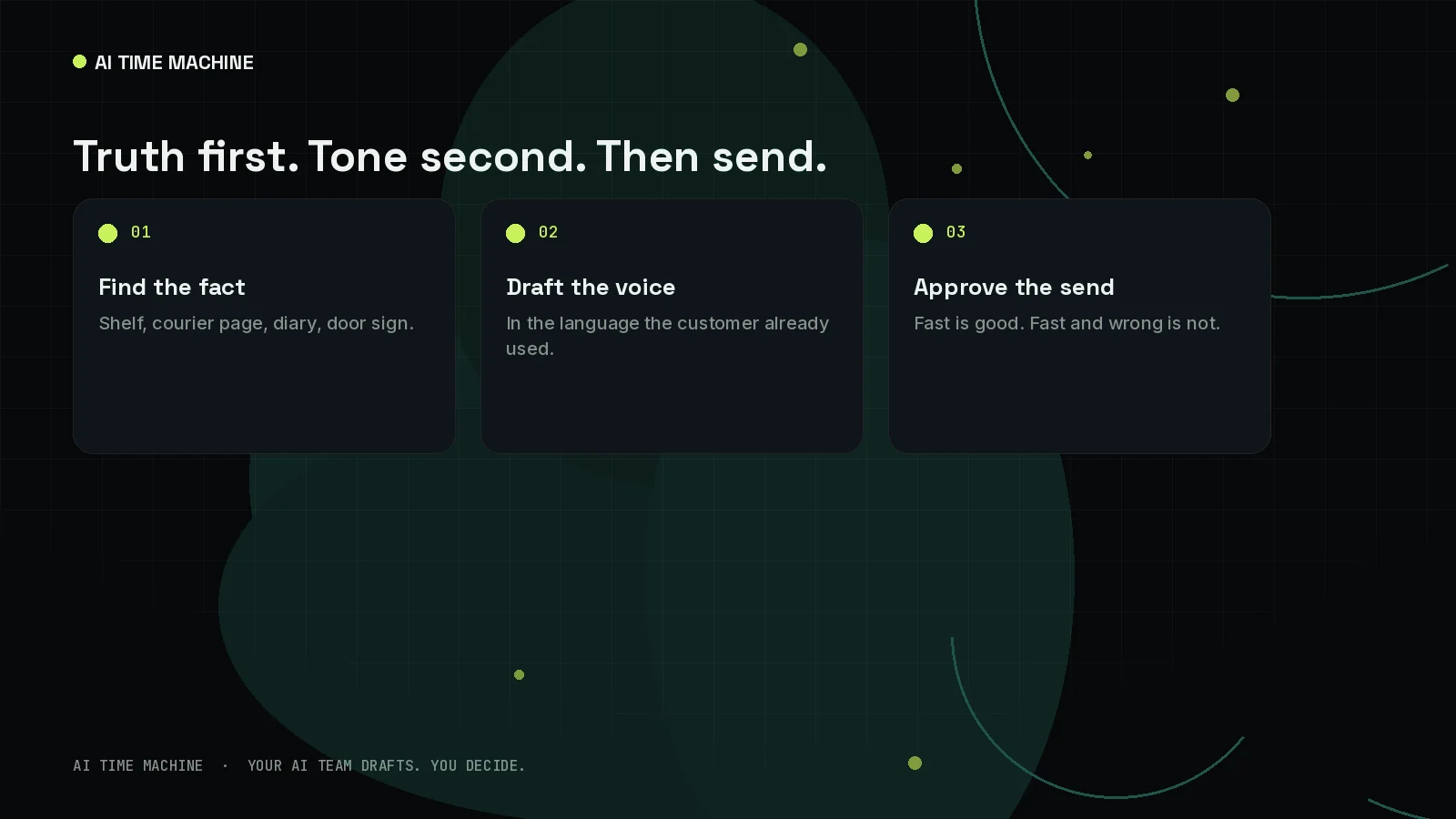
The way to be faster is to start writing before you are ready to send. When a message arrives, an agent can prepare a reply in your tone while you check the fact. You drop the fact in, you read the whole thing once, and you say yes.
That is very different from automatic replies. An automatic “your order is on the way” is a problem if it is not. An automatic “we are sorry you feel that way” is a problem if the person had a real reason. Speed without truth is just a faster mistake.
If you use a tool like AI Time Machine, customer-reply, tracking, returns, and review agents exist for this pattern. They draft. They wait. WhatsApp replies do not send themselves. Late messages can sit with a draft ready in the morning, which is often better than a bleary answer at midnight.
The two-pass reply
First pass: facts. Open the source of truth and write the part only you can know. The tracking number, the remaining size, the next appointment, the actual refund path. If you do not know yet, say so and say when you will know. “I am checking with the courier and will write by 5 pm” is a complete reply. A guessed time is not.
Second pass: warmth and brevity. Cut any sentence that repeats another sentence. Cut any policy language the customer does not need. Add one human line if it is true: thank you for waiting, I am sorry this was late, I remember you bought the blue one last month. Do not add a human line that is false. People can hear false warmth through a screen.
Then send. If you cannot send yet, tell the person you have seen the message. A short acknowledgement plus a later true answer beats a long silence and a perfect paragraph.

When the customer is upset
Anger is a reason to slow the send, not to freeze. Read the message twice. Find the request underneath the heat: a replacement, a refund, an explanation, an apology, or simply to be believed. A draft can give you a calm opening paragraph so you do not type while you are also angry.
Do not argue about tone in the first reply. Do not forward a complaint to a public review and do not ask the person to “take it off” as a condition of help. Say what you can do, what you cannot do, and what happens next. If money will move, only describe a path you will actually follow. No agent should issue a refund on its own, and no sentence should say that it already happened.
If a member of staff is named, take the draft off the fast path. That is a conversation with a person, possibly a private one, and it deserves your full attention.
A weekly tidy so the list stays honest
Once a week, look at the questions you actually received. Update the fact sheet. Retire a reply that is no longer true. Add a new regular question. This is dull work and it is how you stay fast next week.
If the same complaint appears three times, the answer is not a better template. The answer may be a better process: a clearer delivery estimate on the website, a note on the door, a photograph of the actual size. Writing cannot fix a fact that keeps surprising people. It can only stop you from being surprised in public, one message at a time.
Faster replies are a habit of preparation. You prepare the facts, you prepare the tone, you prepare the draft, and you still press send yourself. That is not old-fashioned. It is how a small business stays trusted while it gets quicker.
Channels change the sentence, not the truth
A reply on WhatsApp can be shorter than a reply on email. A reply under a public review should be careful enough to stand alone, because strangers will read it without the rest of the story. A reply on Instagram should not include a payment link you would rather keep in a private message. The fact stays the same. The wrapping changes.
Write that down as well. “Hours questions can be one line on WhatsApp and a slightly fuller sentence on Google.” “Refunds are never discussed in a public comment; we invite the person to a private message and then follow the policy.” When a draft ignores the channel, fix the draft and mention the channel in the brief next time.
It is also worth deciding who is allowed to approve what, if more than one person reads the queue. A helper may approve hours and tracking when the facts are in front of them. Only you may approve a refund, a complaint, or anything that names a person. Write that split down. Informal permission disappears on a busy Saturday, and that is exactly when a risky message tries to leave.
If two people might answer the same thread, say so inside the business, not to the customer in a confusing way. One voice, one fact sheet, and one person who sends is faster than two overlapping drafts. The customer should not have to compare two slightly different answers to find the true one.