Operations
Draft first, send later: why every customer message should wait for your yes

The fastest way to damage a small business with software is to let it talk to customers without you. A wrong price, a wrong promise, a sharp tone on a bad day — these are not abstract risks. They are messages with your name at the top, sitting on someone’s phone.
Automation still has a place. The place is the draft, not the send. This article is about why every customer message should wait for a yes, and how to review those drafts quickly enough that the habit survives a busy afternoon.
Speed is not the same as carelessness
Owners reach for automatic sending because they are tired of late replies. That tiredness is real. A customer who asked “is this in stock?” at noon should not have to wait until night. The answer is not to let a tool guess the stock and press send. The answer is to make the first draft appear in seconds, then take the thirty seconds only a human can take: is this true, and is this kind?
Those thirty seconds are not wasted time. They are the difference between a shop that sounds like itself and a shop that sounds like a template. Customers forgive a slightly slower reply more easily than they forgive a confident error.
If you want speed, prepare the parts that do not change. Save your tone. Save the sentences you always use for returns. Keep the facts close — the tracking page, the shelf, the diary. Then the approval is a check, not a writing assignment.
What slips out when nobody approves
The failures are ordinary. A tool wishes a customer a happy festival on the wrong date. A follow-up offers a discount you do not give. A refund reply tells someone the money is on the way when it is not. A clinic-style business gets a draft that sounds like medical advice. An agency sends a proposal with another client’s name still in it.
None of these require a malicious system. They only require a system that is allowed to finish the job. Once a message is sent, you are negotiating with memory. The customer has a screenshot. Your correction, however polite, is a second message about a mistake you did not need to make.
There is also a quieter failure: tone. A complaint answered in official language can sound cold. A sales nudge that uses urgency you do not feel can sound like a trick. You would not let a new hire send those without a look. An agent is a new hire that never sleeps and never feels embarrassed. That is a reason to look, not a reason to look away.
A yes queue that respects the day
A review habit only works if the queue is short and obvious. Put the drafts in one place. Show the customer, the channel, and the first line. Let yourself edit before you approve. Let yourself leave a draft overnight if you are unsure. Never let a draft send itself because you got busy.
In practice, batch the easy ones. Morning tracking questions can be checked in a group when you have the dispatch list in front of you. Reviews can wait for a quieter cup of tea, because a review is public. Sales follow-ups can wait until you know you actually want the work.
If the day is too full, pause. A paused team is better than a team that “helpfully” continues. In AI Time Machine, drafts wait in a yes queue and a single switch pauses everyone. Agents do not run unattended in the background yet. Use that limit. It exists so a busy day does not become a public one.
How to review a draft in under a minute
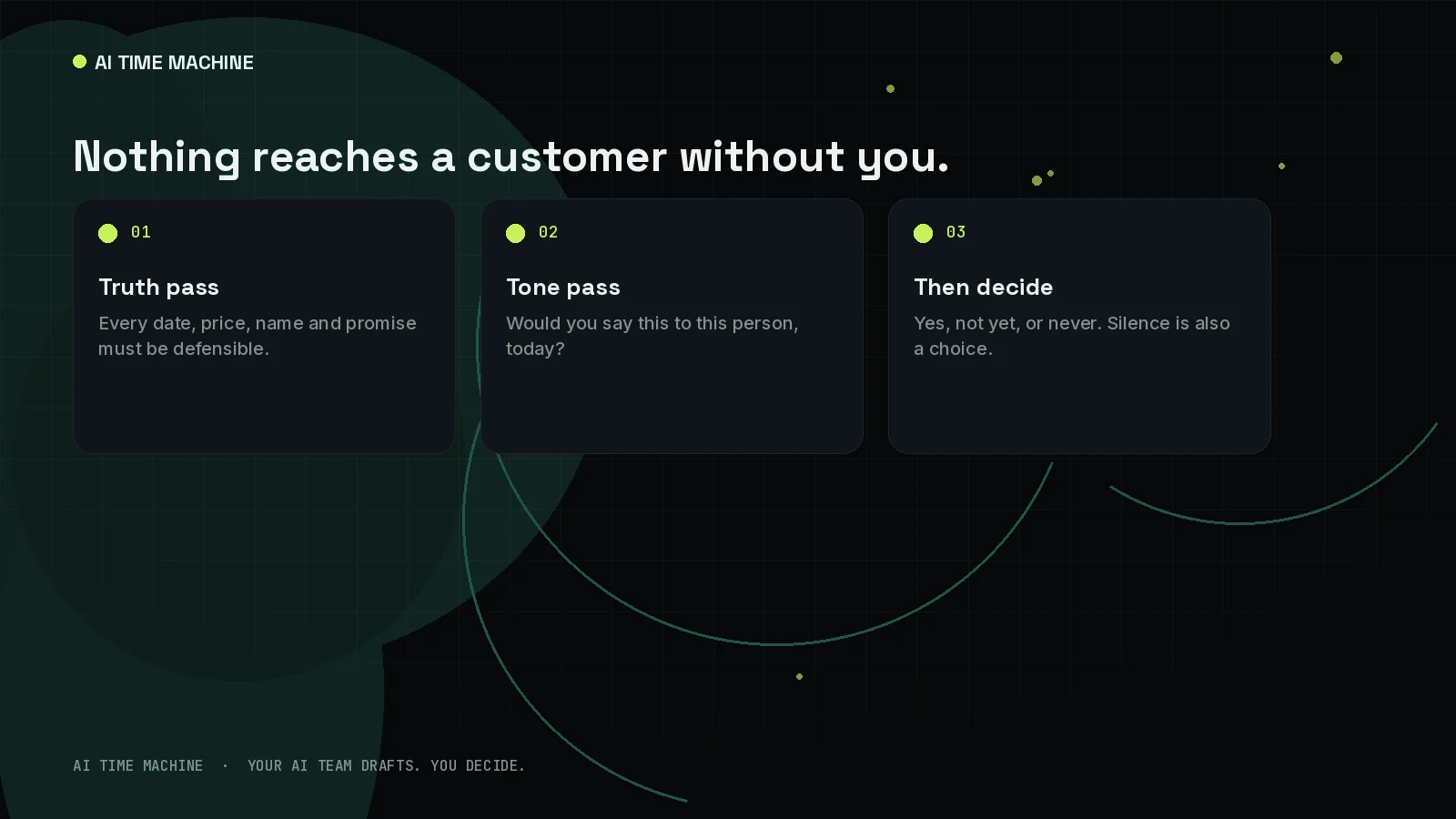
Read it once for truth. Every date, price, name, and promise should be something you could defend at the counter. If a fact is missing, add it or cut the sentence. Do not let a smooth paragraph cover a hole.
Read it a second time for tone, but only a second time. Ask: would I say this to this person, in this channel, today? If the answer is no, change the words, not just a comma. Cut anything that sounds like a brochure. Cut anything that blames the customer. Cut urgency you do not mean.
Then decide. Yes, not yet, or never. “Never” is useful. Not every almost-sale needs a nudge. Not every review needs a paragraph. An agent will happily write more than you should send. Your job is to be the person who can choose silence.

Special cases that always need a slower yes
Some messages should never be batched. A complaint that mentions a staff member. A medical, legal, or financial question. A request for a refund or a chargeback. A message from a journalist or a public official. A conversation that is already angry.
For those, the draft is still useful — it gives you a calm starting point — but the send should wait until you have the file, the policy, and, if needed, another human. If you do not have a policy, write one after you have handled the case, not in the reply itself.
Also slow down when the tool is asking you to spend money or change a price in public. A suggested ad boost, a festival discount, or a “today only” line is not a caption. It is a commercial decision. Treat it like one.
Building the habit without adding a second job
The fear is that approvals become a new inbox. They will, if you let every kind of draft arrive at every hour and you try to handle each one as it appears. They will not, if you choose windows: a morning pass, a mid-afternoon pass, a last look before you leave.
Tell anyone who works with you that messages go out after a check, not the instant a draft exists. If you have a helper at the counter, they can flag the facts; you still own the yes, or you formally hand them that yes for a narrow class of replies.
Write down the few replies that are pre-approved in substance — store hours, the official return window, the correct UPI or payment link — and still glance at them, because facts change. Revoke a pre-approval the moment it is stale.
The aim is not to be slow. The aim is to be the last person who sees a message before a customer does. That is a modest standard. It is also how a small business stays itself while it uses new tools.
What this looks like after a month
If you keep the habit for four weeks, two things usually change. The first is the length of the drafts. Early drafts will be too long, because a tool would rather be complete than brief. After you have cut the same phrases a few times, you can add those cuts to the brief, and the later drafts arrive closer to something you would actually send.
The second is your own nerve. The first week, every approval feels like a ceremony. By the fourth week, a tracking reply is a glance, a public review is still a careful read, and a complaint is still slow. That difference is the point of a queue: not every message has the same weight, but every message still has a person attached to it.
You will also learn which requests should never have been written at all. If you keep deleting the same kind of nudge, stop asking for it. An empty queue is not a failure. It is a week in which you did not bother people.
Keep a short log, if you like, of the two or three approvals that were hard, and why. You do not need a dashboard for this. A note on your phone is enough. Those notes become the next version of your rules, which is how a small business builds a voice that lasts longer than any one tool.