Sales agent · Retail
AI Sales Agent for Retail
An AI sales agent for retail is a language-model agent that answers buyer questions, qualifies leads and drafts follow-ups and quotes for retail stores and multi-location retailers. It works in tools such as CRM and POS and retail management, follows written rules for retail, and leaves money, terms and personal data decisions to a person.
What is an AI sales agent for retail?
Retailers combine physical stores with online channels, so questions about stock, store hours, orders and promotions come from everywhere. An AI sales agent for retail applies the AI sales agent idea to that setting: a sales agent sits between your lead sources and your sales team. Instead of a fixed chatbot script, it reads each conversation, decides the next useful step, calls a tool (look up a product, check stock, create a CRM task) and writes a reply or draft in your voice.
For retail stores and multi-location retailers, the people on the other side are shoppers. The agent has to speak their language, respect the rules of the sector and work inside the systems the team already uses rather than adding another dashboard.
What does an AI sales agent for retail do?
Its core job in retail: it answers buyer questions, qualifies leads and drafts follow-ups and quotes. A common sales task for retail stores and multi-location retailers: the agent answers product and stock questions, reserves items for pickup and follows up with interested shoppers. For example: A shopper asks if a jacket in medium is at the Andheri store; the agent checks stock and reserves it for pickup today.
Tasks it can take on for retail stores and multi-location retailers
- Reply to inbound enquiries within minutes, around the clock
- Ask qualifying questions (budget, timeline, use case) and score the lead
- Draft personalised follow-ups after calls, demos or quiet periods
- Prepare quotes and price-list answers from approved pricing only
- Log activities, notes and next steps to the CRM
- Hand hot leads to a human with a short summary of the conversation
Day-to-day pressures in retail
- Customers call stores to ask about stock
- Promotions are inconsistent across stores
- Store managers buried in admin
- Local listings out of date
How does an AI sales agent for retail work?
Recommended architecture: single agent with tools. The model runs a loop: read the request, decide which tool to call, read the tool result, and repeat until it can answer or needs a person. This is the reason-and-act (ReAct) pattern most frameworks implement.
Why this pattern fits: requests vary a lot from one conversation to the next, so a fixed script would break. A tool loop lets the agent take a different path each time while the tools themselves stay narrow and safe. Anthropic's guide to agent design makes the same point: start with the simplest pattern that works and add autonomy only when it clearly helps (Anthropic: Building effective agents).
| Component | Role in this agent | Example options |
|---|---|---|
| Language model | Reads the request, decides the next step and writes drafts | GPT, Claude, Gemini, or open-weight models such as Llama, Qwen or Mistral via a gateway like LiteLLM |
| Tools | Actions the agent may take: CRM, Email inbox, Website chat or WhatsApp Business, Calendar booking links | Function calling or Model Context Protocol (MCP) servers |
| Industry systems | Where customer records and day-to-day work items live | POS and retail management, Inventory and replenishment, Loyalty and CRM |
| Knowledge (RAG) | Index the price list, product pages and objection-handling notes; retrieve the top passages per question and cite them in internal notes. | A vector store such as Chroma or Qdrant, or your database's search |
| Memory | Short-term conversation state plus a per-contact summary stored on the CRM record so the next touch knows what was promised. | CRM or database records; a memory layer such as Mem0 or Zep for longer histories |
| Orchestration | Single agent with tools | langgraph or crewAI |
| Guardrails & approval | Quotes, discounts, contracts and the first message to a new segment are approved by a person. | Approval queue, allow-listed actions, logging |
Data the agent needs
- Product catalogue and store stock levels
- Store hours, services and policies
- Promotions calendar
- Loyalty programme rules
- Product and pricing sheet
- Past won and lost deal notes
What does an AI sales agent for retail workflow look like?
A typical run, from trigger to a logged result in retail:
- New enquiry arrives from form, chat or email
- Agent enriches the contact from the CRM and classifies intent
- Agent answers questions using retrieved product facts
- Agent proposes a next step (call, quote, demo) and drafts the message
- A rep approves or edits; the agent logs the outcome to the CRM
How do you build an AI sales agent for retail, step by step?
- Define the scope. Pick two or three tasks to automate first (for example: reply to inbound enquiries within minutes, around the clock; ask qualifying questions (budget, timeline, use case) and score the lead). Write down what the agent must never do.
- Collect the knowledge. Gather product catalogue and store stock levels and store hours, services and policies. Clean, current documents matter more than model choice.
- Choose the stack. Use the single agent with tools pattern. Free options include langchain-ai/langgraph, crewAIInc/crewAI, openai/openai-agents-python; pick one your team can maintain.
- Connect the tools. Give the agent narrow, least-privilege access to CRM, Email inbox, Website chat or WhatsApp Business and POS and retail management. Start read-only where you can.
- Write the instructions. Write a system prompt with the role, allowed sources, tone, limits and when to hand off. Keep examples of good outputs next to it.
- Add retrieval and memory. Index the price list, product pages and objection-handling notes; retrieve the top passages per question and cite them in internal notes. Short-term conversation state plus a per-contact summary stored on the CRM record so the next touch knows what was promised.
- Add guardrails and approvals. Quotes, discounts, contracts and the first message to a new segment are approved by a person. Log every tool call and output.
- Evaluate before launch. Replay 50 real past enquiries and grade the agent's replies for accuracy, tone and correct next step before going live.
- Launch small and monitor. Roll out to one team, channel or segment. Track speed to first reply and lead-to-meeting rate, review failures weekly and expand only when quality holds.
You are the sales assistant for {company}. Answer only from the product sheet provided. Qualify the lead on budget, timeline and use case. Never offer a discount. If the lead is ready, propose two meeting slots and draft the email for approval.For model tool use, see the official guides on OpenAI: Function calling guide and Anthropic: Tool use with Claude. OpenAI's practical guide to building agents covers instructions, tools and guardrails in more depth.
Which free, open-source repos can you use to build an AI sales agent for retail?
Each repository below was checked on GitHub on 2026-11-26. Licences differ, and some "fair-code" or source-available licences limit commercial hosting, so read the licence before you ship.
| Repository | What it is | Licence | Language |
|---|---|---|---|
| langchain-ai/langgraph | Library for stateful, controllable agent graphs with human-in-the-loop support | MIT | Python |
| crewAIInc/crewAI | Python framework for role-based multi-agent crews | MIT | Python |
| openai/openai-agents-python | OpenAI's Python SDK for agents, handoffs, guardrails and tracing | MIT | Python |
| n8n-io/n8n | Workflow automation platform with AI agent nodes, self-hostable | Custom / source-available (read the repo licence) | TypeScript |
| twentyhq/twenty | Open-source CRM with an API an agent can read and update | Custom / source-available (read the repo licence) | TypeScript |
Which AI platforms offer AI sales agents?
If you would rather buy than build, these commercial products offer agents or features for this job. We list them for reference only; we are not affiliated with them, and features and pricing change, so check each vendor's site.
| Platform | Type |
|---|---|
| Salesforce Agentforce | CRM-native agent platform |
| HubSpot Breeze | CRM and marketing AI |
| 11x | AI sales development workers |
| Qualified | Website pipeline generation and AI SDR |
Build, buy, or start with ready-made agents?
| Option | Effort | Cost model | Best for |
|---|---|---|---|
| Build with open source | High: engineering, hosting, evaluation | Free code; you pay for models and hosting | Teams with developers that need full control or custom integrations |
| Commercial agent platform | Medium: configuration and integration | Usually subscription or per-conversation pricing | Companies already on that vendor's CRM or marketing stack |
| AI Time Machine (55 ready-made agents) | Low: sign in, connect your own AI key, choose agents | One-time payment | Small businesses that want drafts for everyday sales, support, marketing and admin work, approved by a person |
How do you measure an AI sales agent for retail?
Measure outcomes, not activity. Set a baseline before launch so you can show the change:
| Metric | How to measure it |
|---|---|
| Speed to first reply | Median minutes from enquiry to first useful answer |
| Lead-to-meeting rate | Share of qualified leads that book a call |
| Follow-up coverage | Percent of open deals with a next step logged |
| Stock-out rate | Items unavailable when customers ask |
| Click-and-collect conversion | Reservations that are picked up |
What are the risks of an AI sales agent for retail, and how do you control them?
| Risk | Control |
|---|---|
| Promising discounts or terms that were never approved | Restrict pricing to a read-only price tool and require human approval on any quote |
| Contacting people who opted out | Check consent and suppression lists before every send |
| Hallucinated product facts | Answer only from retrieved product docs and say 'I'll check' otherwise |
Rules and standards to check in retail
- Payment card security under PCI DSS (PCI SSC)
- Consumer privacy laws for loyalty data (California Attorney General)
- Product data standards for barcodes and catalogue (GS1)
This is general information, not legal advice. Requirements depend on your country, state and use case.
General AI security risks such as prompt injection, data leakage and excessive agent permissions are catalogued in the OWASP GenAI Security Project: OWASP Top 10 for LLM Applications. For governance, the NIST: AI Risk Management Framework is a widely used framework.
Can AI Time Machine help with sales work in retail?
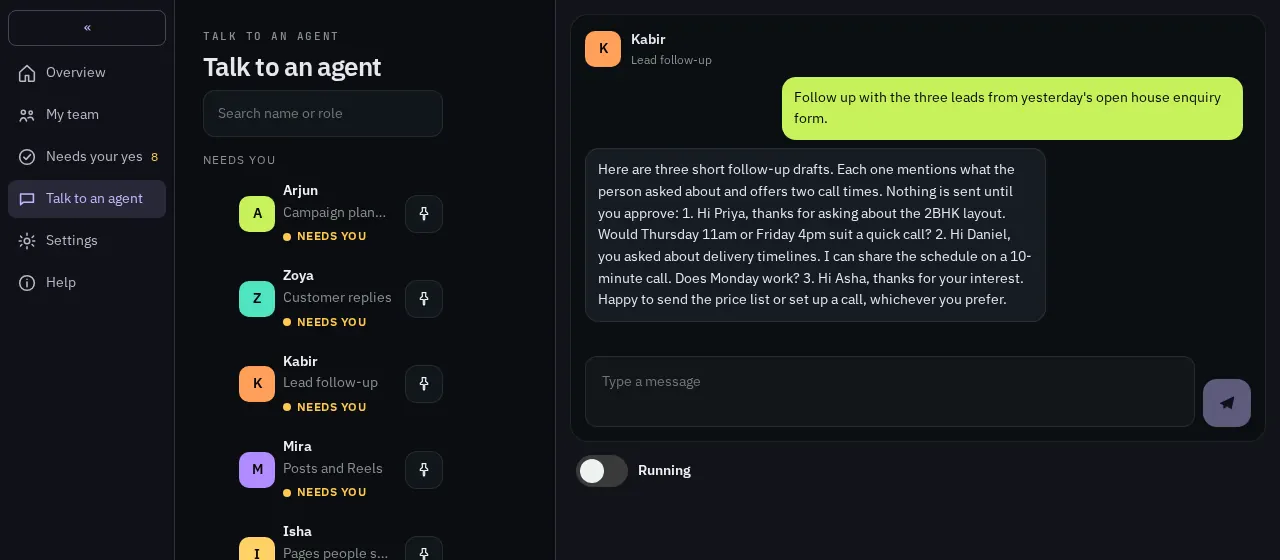
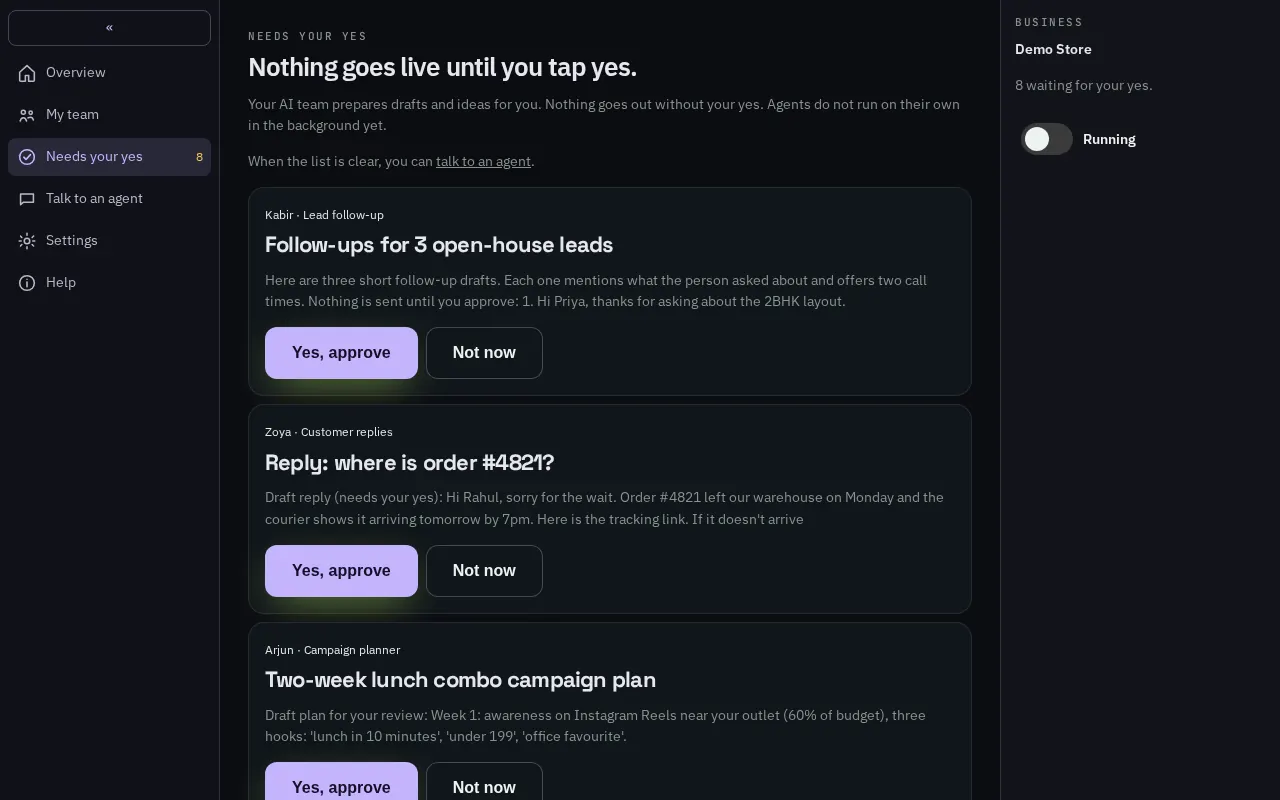
AI Time Machine is a set of 55 ready-made AI agents in 8 teams for small businesses. It is not a custom agent builder and does not connect to CRM on its own. The agents closest to this job draft work in their role, using the AI provider key you connect, and nothing goes out until you approve it:
- Kabir, Lead follow-up (Sales): Follows people who asked about what you sell. Sends nothing until you approve.
- Harsh, New leads (Sales): Greets a new enquiry and asks the one next question.
- Naina, Quotes (Sales): Turns a price list into a clear quote.
- Rehan, Quiet carts (Sales): Drafts a nudge for people who almost bought.
- Yash, Price lists (Sales): Turns your prices into a message a customer can understand.
Frequently asked questions
Can an AI sales agent close deals on its own?
It can move simple, low-value orders to checkout, but for most businesses it should qualify, follow up and prepare quotes while a person approves pricing and terms.
Which CRM works best with an AI sales agent?
Any CRM with an API works. HubSpot, Salesforce, Pipedrive and Zoho all expose contacts, deals and tasks that an agent can read and update.
How long does it take to build one?
A basic inbound-reply and follow-up agent on n8n or LangGraph takes a few days; CRM write-back, approvals and evaluation usually take two to four weeks.
Can an AI agent check store stock for customers?
Yes, if it can read live inventory by location. Show a 'reserve for pickup' option rather than promising stock that may sell out.
Can a small retail business build an AI sales agent for retail without developers?
Partly. No-code tools such as n8n, Dify or Langflow can connect a model to POS and retail management and email for a first version. Integrations with Inventory and replenishment, approvals and testing usually need some technical help.
Sources and further reading
- Building effective agents — Anthropic
- A practical guide to building agents — OpenAI
- ReAct: Synergizing Reasoning and Acting in Language Models — Yao et al., arXiv 2210.03629
- AI Risk Management Framework — NIST
- OWASP Top 10 for LLM Applications — OWASP GenAI Security Project
- Function calling guide — OpenAI
- Retrieval-Augmented Generation for Knowledge-Intensive NLP Tasks — Lewis et al., arXiv 2005.11401
- Tool use with Claude — Anthropic
- PCI Security Standards — PCI SSC
- California Consumer Privacy Act — California Attorney General
- GS1 standards (barcodes, product data) — GS1
Need an AI sales agent for retail? Tell us what you need
Tell us what you want the agent to do. We read every request and reply by email, usually within two business days, with an honest view of whether our ready-made agents fit or what a custom build would involve.
Or start today with 55 ready-made AI agents
AI Time Machine gives a small business 55 agents in 8 teams (sales, support, marketing, content, SEO, operations, money and a CEO office). They draft the work, you approve it, and they use the AI provider key you connect. One-time payment, no subscription.