HR & recruiting agent · Education
AI Recruiting Agent for Education
An AI recruiting agent for education is a language-model agent that summarises applications against job criteria, answers candidates and schedules interviews for schools, colleges, coaching institutes and edtech companies. It works in tools such as Applicant tracking system and Student information system, follows written rules for education, and leaves money, terms and personal data decisions to a person.
What is an AI recruiting agent for education?
Education providers handle admissions enquiries, timetables, fee questions and learning support, with peaks around enrolment and exams. An AI recruiting agent for education applies the AI recruiting agent idea to that setting: recruiting agents automate the administrative load around hiring: writing job posts, reading CVs, chasing scheduling and keeping candidates informed, so recruiters spend more time talking to people.
For schools, colleges, coaching institutes and edtech companies, the people on the other side are students and parents. The agent has to speak their language, respect the rules of the sector and work inside the systems the team already uses rather than adding another dashboard.
What does an AI recruiting agent for education do?
Its core job in education: it summarises applications against job criteria, answers candidates and schedules interviews. A common hr & recruiting task for schools, colleges, coaching institutes and edtech companies: the agent supports hiring of teachers and staff. For example: For a maths teacher vacancy, the agent checks qualifications listed in each application and schedules demo lessons.
Tasks it can take on for schools, colleges, coaching institutes and edtech companies
- Draft inclusive job descriptions
- Source candidates from approved databases and referrals
- Summarise CVs against must-have and nice-to-have criteria
- Answer candidate FAQs about role, process and benefits
- Schedule interviews across interviewer calendars
- Send status updates so no candidate is left waiting
Day-to-day pressures in education
- Admissions teams overwhelmed in peak season
- Repeated questions about fees and timetables
- Teachers short of time for feedback
- Students drop off without anyone noticing
How does an AI recruiting agent for education work?
Recommended architecture: fixed pipeline (prompt chaining). Work moves through ordered steps, each with its own narrow prompt and a check between steps: for example extract, validate, draft, review. If a check fails, the item stops and goes to a person.
Why this pattern fits: the task has a known shape. Splitting it into steps makes each step more accurate and lets you test and improve them one at a time. Anthropic's guide to agent design makes the same point: start with the simplest pattern that works and add autonomy only when it clearly helps (Anthropic: Building effective agents).
| Component | Role in this agent | Example options |
|---|---|---|
| Language model | Reads the request, decides the next step and writes drafts | GPT, Claude, Gemini, or open-weight models such as Llama, Qwen or Mistral via a gateway like LiteLLM |
| Tools | Actions the agent may take: Applicant tracking system, Job boards, Calendar, Email and SMS | Function calling or Model Context Protocol (MCP) servers |
| Industry systems | Where customer records and day-to-day work items live | Student information system, Learning management system, Admissions CRM |
| Knowledge (RAG) | Retrieve the scorecard, role FAQ and process guide for each candidate interaction. | A vector store such as Chroma or Qdrant, or your database's search |
| Memory | Candidate record in the ATS with stage, notes and communications; no memory outside the ATS. | CRM or database records; a memory layer such as Mem0 or Zep for longer histories |
| Orchestration | Fixed pipeline (prompt chaining) | crewAI or langgraph |
| Guardrails & approval | All shortlisting, rejection and offer decisions are made by people. | Approval queue, allow-listed actions, logging |
Data the agent needs
- Course catalogue, fees and schedules
- Admissions criteria and deadlines
- Policies and student handbook
- Approved learning materials
- Job descriptions and scorecards
- Interview process and FAQs
What does an AI recruiting agent for education workflow look like?
A typical run, from trigger to a logged result in education:
- Role opened with a scorecard
- Agent drafts the job post for approval
- Applications summarised against the scorecard with evidence
- Recruiter reviews shortlist and decides
- Agent schedules interviews and keeps candidates updated
How do you build an AI recruiting agent for education, step by step?
- Define the scope. Pick two or three tasks to automate first (for example: draft inclusive job descriptions; source candidates from approved databases and referrals). Write down what the agent must never do.
- Collect the knowledge. Gather course catalogue, fees and schedules and admissions criteria and deadlines. Clean, current documents matter more than model choice.
- Choose the stack. Use the fixed pipeline (prompt chaining) pattern. Free options include crewAIInc/crewAI, langchain-ai/langgraph, frappe/hrms; pick one your team can maintain.
- Connect the tools. Give the agent narrow, least-privilege access to Applicant tracking system, Job boards, Calendar and Student information system. Start read-only where you can.
- Write the instructions. Write a system prompt with the role, allowed sources, tone, limits and when to hand off. Keep examples of good outputs next to it.
- Add retrieval and memory. Retrieve the scorecard, role FAQ and process guide for each candidate interaction. Candidate record in the ATS with stage, notes and communications; no memory outside the ATS.
- Add guardrails and approvals. All shortlisting, rejection and offer decisions are made by people. Log every tool call and output.
- Evaluate before launch. Audit screening summaries on a labelled set for accuracy and check selection rates across groups before use.
- Launch small and monitor. Roll out to one team, channel or segment. Track time to first contact and time to hire, review failures weekly and expand only when quality holds.
Summarise this CV against the scorecard. For each must-have, quote the evidence or write 'not found'. Do not infer age, gender, ethnicity or other protected traits. Do not give a hire or reject decision.For model tool use, see the official guides on OpenAI: Function calling guide and Anthropic: Tool use with Claude. OpenAI's practical guide to building agents covers instructions, tools and guardrails in more depth.
Which free, open-source repos can you use to build an AI recruiting agent for education?
Each repository below was checked on GitHub on 2026-11-26. Licences differ, and some "fair-code" or source-available licences limit commercial hosting, so read the licence before you ship.
| Repository | What it is | Licence | Language |
|---|---|---|---|
| crewAIInc/crewAI | Python framework for role-based multi-agent crews | MIT | Python |
| langchain-ai/langgraph | Library for stateful, controllable agent graphs with human-in-the-loop support | MIT | Python |
| frappe/hrms | Open-source HR and payroll system (Frappe) that an agent can read and update | GPL-3.0 | Python |
| pydantic/pydantic-ai | Typed Python agent framework with structured outputs | MIT | Python |
| n8n-io/n8n | Workflow automation platform with AI agent nodes, self-hostable | Custom / source-available (read the repo licence) | TypeScript |
Which AI platforms offer AI recruiting agents?
If you would rather buy than build, these commercial products offer agents or features for this job. We list them for reference only; we are not affiliated with them, and features and pricing change, so check each vendor's site.
| Platform | Type |
|---|---|
| Paradox | Conversational recruiting assistant |
| Workday | HR and finance suite with AI agents |
| Greenhouse | Applicant tracking system |
| Lever | Applicant tracking and CRM |
Build, buy, or start with ready-made agents?
| Option | Effort | Cost model | Best for |
|---|---|---|---|
| Build with open source | High: engineering, hosting, evaluation | Free code; you pay for models and hosting | Teams with developers that need full control or custom integrations |
| Commercial agent platform | Medium: configuration and integration | Usually subscription or per-conversation pricing | Companies already on that vendor's suite |
| AI Time Machine (55 ready-made agents) | Low: sign in, connect your own AI key, choose agents | One-time payment | Small businesses that want drafts for everyday sales, support, marketing and admin work, approved by a person |
How do you measure an AI recruiting agent for education?
Measure outcomes, not activity. Set a baseline before launch so you can show the change:
| Metric | How to measure it |
|---|---|
| Time to first contact | Hours from application to candidate update |
| Time to hire | Days from opening to accepted offer |
| Interview scheduling time | Hours spent arranging interviews |
| Enquiry-to-enrolment rate | Admissions enquiries that enrol |
| Student query response time | Hours to answer student and parent questions |
What are the risks of an AI recruiting agent for education, and how do you control them?
| Risk | Control |
|---|---|
| Discriminatory screening | Screen only on job-related criteria, test for adverse impact, and keep humans deciding |
| Legal requirements on automated hiring tools | Check rules such as NYC Local Law 144, the EU AI Act high-risk obligations and EEOC guidance |
| Candidate data privacy | Limit retention and access, and tell candidates how AI is used |
Rules and standards to check in education
- FERPA and student privacy rules for education records (U.S. Department of Education)
- UNESCO guidance on AI in education (UNESCO)
- Child data protection and parental consent rules (gdpr-info.eu)
This is general information, not legal advice. Requirements depend on your country, state and use case.
General AI security risks such as prompt injection, data leakage and excessive agent permissions are catalogued in the OWASP GenAI Security Project: OWASP Top 10 for LLM Applications. For governance, the NIST: AI Risk Management Framework is a widely used framework.
Can AI Time Machine help with hr & recruiting work in education?
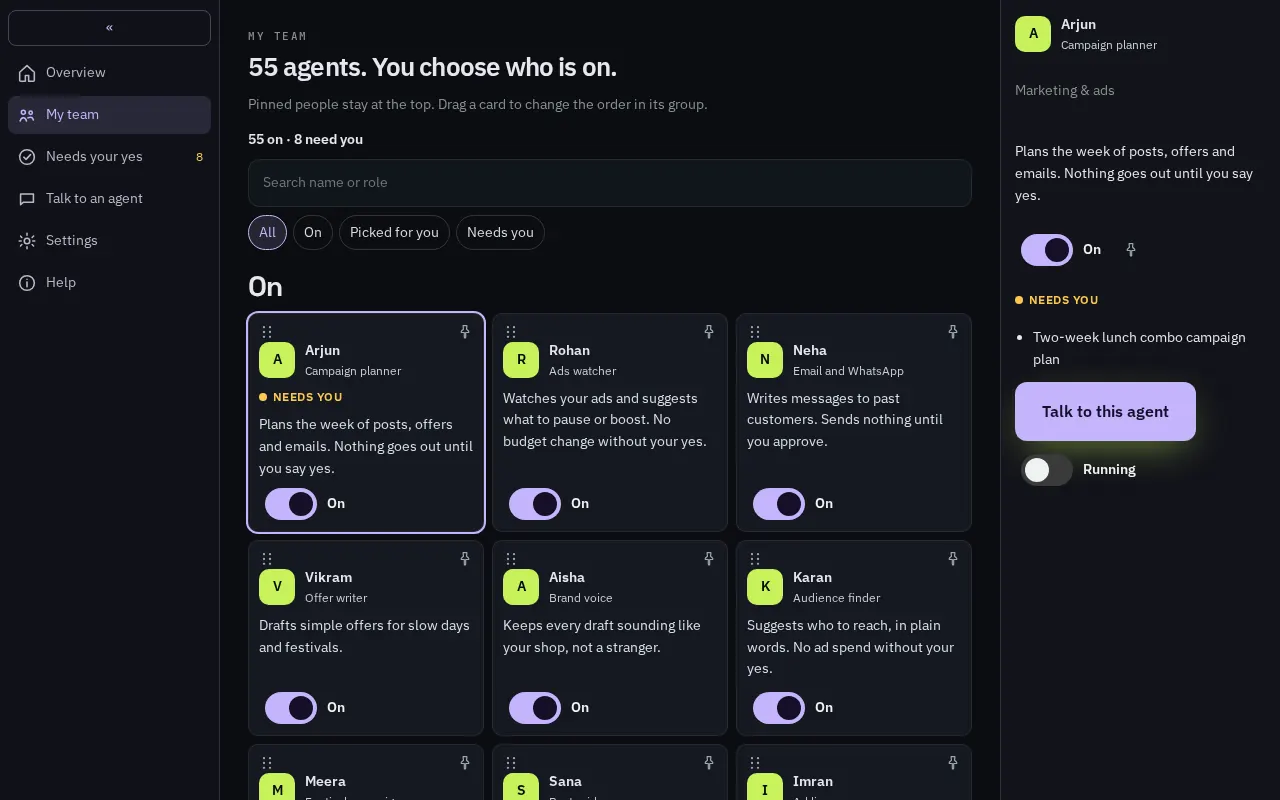
AI Time Machine is a set of 55 ready-made AI agents in 8 teams for small businesses. It is not a custom agent builder and does not connect to Applicant tracking system on its own. The agents closest to this job draft work in their role, using the AI provider key you connect, and nothing goes out until you approve it:
- Shreya, Task reminders (Ops): Nudges you about what you already said yes to.
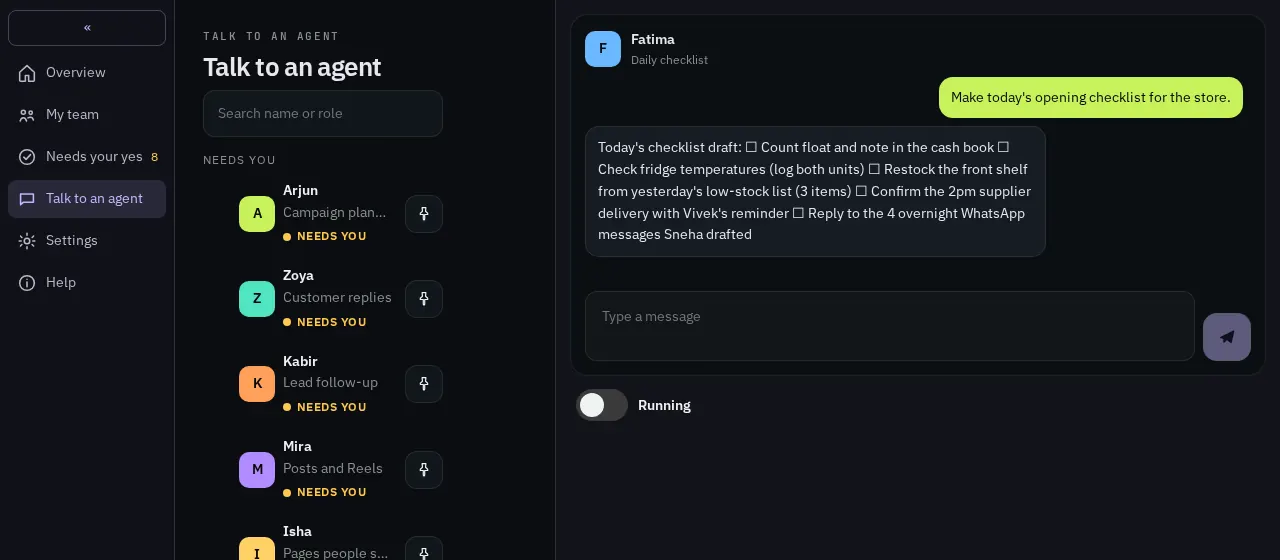
- Fatima, Daily checklist (Ops): Gives you a short list for the day.
Frequently asked questions
Is it legal to use AI to screen candidates?
Often yes, with conditions. Some jurisdictions require bias audits, notices or human review, and the EU AI Act treats recruitment AI as high-risk. Get legal advice for your region.
Can an AI recruiter reject candidates automatically?
It should not. Use it to summarise and organise, and keep people responsible for decisions.
Does it help with interview scheduling?
Yes, scheduling is one of the clearest wins because it is repetitive and rule-based.
Is it safe to use AI agents with students?
Yes with care: limit personal data, follow student privacy law, keep teachers in charge of assessment, and use age-appropriate content controls.
Can a small education business build an AI recruiting agent for education without developers?
Partly. No-code tools such as n8n, Dify or Langflow can connect a model to Student information system and email for a first version. Integrations with Learning management system, approvals and testing usually need some technical help.
Sources and further reading
- Building effective agents — Anthropic
- A practical guide to building agents — OpenAI
- AI Risk Management Framework — NIST
- OWASP Top 10 for LLM Applications — OWASP GenAI Security Project
- Retrieval-Augmented Generation for Knowledge-Intensive NLP Tasks — Lewis et al., arXiv 2005.11401
- Model Context Protocol — modelcontextprotocol.io
- FERPA — U.S. Department of Education
- Artificial intelligence in education — UNESCO
- General Data Protection Regulation (text) — gdpr-info.eu
Need an AI recruiting agent for education? Tell us what you need
Tell us what you want the agent to do. We read every request and reply by email, usually within two business days, with an honest view of whether our ready-made agents fit or what a custom build would involve.
Or start today with 55 ready-made AI agents
AI Time Machine gives a small business 55 agents in 8 teams (sales, support, marketing, content, SEO, operations, money and a CEO office). They draft the work, you approve it, and they use the AI provider key you connect. One-time payment, no subscription.