Finance & accounting agent · Accounting firms
AI Expense Audit Agent for Accounting Firms
An AI expense audit agent for accounting firms is a language-model agent that checks expense claims against policy and flags duplicates and anomalies for accounting, bookkeeping and tax firms. It works in tools such as Expense tool and Practice management, follows written rules for accounting firms, and leaves money, terms and personal data decisions to a person.
What is an AI expense audit agent for accounting firms?
Accounting firms face seasonal peaks, document chasing and repetitive client questions, all under professional standards. An AI expense audit agent for accounting firms applies the AI expense audit agent idea to that setting: traditional expense audits sample a few claims. An agent reads every receipt, compares it with policy and transaction data, and explains each flag so reviewers can act quickly.
For accounting, bookkeeping and tax firms, the people on the other side are clients. The agent has to speak their language, respect the rules of the sector and work inside the systems the team already uses rather than adding another dashboard.
What does an AI expense audit agent for accounting firms do?
Its core job in accounting firms: it checks expense claims against policy and flags duplicates and anomalies. A common finance & accounting task for accounting, bookkeeping and tax firms: the agent processes client receipts and invoices and prepares reconciliations for review. For example: Bank statements for a client are categorised and reconciled, with low-confidence items flagged.
Tasks it can take on for accounting, bookkeeping and tax firms
- Read receipts and match them to card transactions
- Check amounts, categories and limits against policy
- Detect duplicates and split transactions
- Spot out-of-policy merchants or weekend spend
- Ask employees for missing details
- Summarise spend trends by team
Day-to-day pressures in accounting firms
- Chasing clients for documents
- Tax-season overload
- Repetitive client questions
- Manual data entry from statements and receipts
How does an AI expense audit agent for accounting firms work?
Recommended architecture: router (classify, then hand off). The model classifies each input into a small set of labels and a confidence score, then fixed code routes it to the right queue, person or follow-up step. The model never acts outside those routes.
Why this pattern fits: the job is a decision, not a conversation. Routing keeps behaviour predictable, cheap to run (small models often suffice) and easy to evaluate against labelled history. Anthropic's guide to agent design makes the same point: start with the simplest pattern that works and add autonomy only when it clearly helps (Anthropic: Building effective agents).
| Component | Role in this agent | Example options |
|---|---|---|
| Language model | Reads the request, decides the next step and writes drafts; a small, fast model is often enough for classification | GPT, Claude, Gemini, or open-weight models such as Llama, Qwen or Mistral via a gateway like LiteLLM |
| Tools | Actions the agent may take: Expense tool, Corporate card feed, Accounting system, HR directory for approvers | Function calling or Model Context Protocol (MCP) servers |
| Industry systems | Where customer records and day-to-day work items live | Practice management, Accounting software, Document portal |
| Knowledge (RAG) | Retrieve relevant policy sections and the employee's recent claims. | A vector store such as Chroma or Qdrant, or your database's search |
| Memory | Employee and merchant history for pattern detection. | CRM or database records; a memory layer such as Mem0 or Zep for longer histories |
| Orchestration | Router (classify, then hand off) | docling or pydantic-ai |
| Guardrails & approval | Rejections, repayments and any disciplinary step are decided by people. | Approval queue, allow-listed actions, logging |
Data the agent needs
- Client engagement letters and scopes
- Chart of accounts and categorisation rules
- Tax deadlines and checklists
- Prior-year workpapers
- Travel and expense policy
- Receipts and card data
What does an AI expense audit agent for accounting firms workflow look like?
A typical run, from trigger to a logged result in accounting firms:
- Claim or card transaction arrives
- Agent reads the receipt and matches the transaction
- Agent checks policy rules and patterns
- Clean claims pass; flagged claims go to a reviewer with reasons
- Reviewer decides; outcomes improve future checks
How do you build an AI expense audit agent for accounting firms, step by step?
- Define the scope. Pick two or three tasks to automate first (for example: read receipts and match them to card transactions; check amounts, categories and limits against policy). Write down what the agent must never do.
- Collect the knowledge. Gather client engagement letters and scopes and chart of accounts and categorisation rules. Clean, current documents matter more than model choice.
- Choose the stack. Use the router (classify, then hand off) pattern. Free options include docling-project/docling, pydantic/pydantic-ai, langchain-ai/langgraph; pick one your team can maintain.
- Connect the tools. Give the agent narrow, least-privilege access to Expense tool, Corporate card feed, Accounting system and Practice management. Start read-only where you can.
- Write the instructions. Write a system prompt with the role, allowed sources, tone, limits and when to hand off. Keep examples of good outputs next to it.
- Add retrieval and memory. Retrieve relevant policy sections and the employee's recent claims. Employee and merchant history for pattern detection.
- Add guardrails and approvals. Rejections, repayments and any disciplinary step are decided by people. Log every tool call and output.
- Evaluate before launch. Run on last quarter's claims and compare flags with known audit findings.
- Launch small and monitor. Roll out to one team, channel or segment. Track audit coverage and policy violation rate, review failures weekly and expand only when quality holds.
Check this expense against the policy excerpt. Return pass or flag, the policy section, and a neutral one-sentence question for the employee if flagged.For model tool use, see the official guides on OpenAI: Function calling guide and Anthropic: Tool use with Claude. OpenAI's practical guide to building agents covers instructions, tools and guardrails in more depth.
Which free, open-source repos can you use to build an AI expense audit agent for accounting firms?
Each repository below was checked on GitHub on 2026-11-26. Licences differ, and some "fair-code" or source-available licences limit commercial hosting, so read the licence before you ship.
| Repository | What it is | Licence | Language |
|---|---|---|---|
| docling-project/docling | Document parser that converts PDFs and office files to structured text for AI | MIT | Python |
| pydantic/pydantic-ai | Typed Python agent framework with structured outputs | MIT | Python |
| langchain-ai/langgraph | Library for stateful, controllable agent graphs with human-in-the-loop support | MIT | Python |
| run-llama/llama_index | Framework for document ingestion, indexing and retrieval agents | MIT | Python |
| n8n-io/n8n | Workflow automation platform with AI agent nodes, self-hostable | Custom / source-available (read the repo licence) | TypeScript |
Which AI platforms offer AI expense audit agents?
If you would rather buy than build, these commercial products offer agents or features for this job. We list them for reference only; we are not affiliated with them, and features and pricing change, so check each vendor's site.
| Platform | Type |
|---|---|
| AppZen | AI for finance teams and expense audit |
| Ramp | Spend management with AI |
| Workday | HR and finance suite with AI agents |
| UiPath | Automation and agentic process platform |
Build, buy, or start with ready-made agents?
| Option | Effort | Cost model | Best for |
|---|---|---|---|
| Build with open source | High: engineering, hosting, evaluation | Free code; you pay for models and hosting | Teams with developers that need full control or custom integrations |
| Commercial agent platform | Medium: configuration and integration | Usually subscription or per-conversation pricing | Companies already on that vendor's suite |
| AI Time Machine (55 ready-made agents) | Low: sign in, connect your own AI key, choose agents | One-time payment | Small businesses that want drafts for everyday sales, support, marketing and admin work, approved by a person |
How do you measure an AI expense audit agent for accounting firms?
Measure outcomes, not activity. Set a baseline before launch so you can show the change:
| Metric | How to measure it |
|---|---|
| Audit coverage | Share of claims reviewed |
| Policy violation rate | Flagged claims confirmed as violations |
| False-positive rate | Flags cleared as fine |
| Documents received on time | Clients who submit by the requested date |
| Returns filed before deadline | Engagements completed early |
What are the risks of an AI expense audit agent for accounting firms, and how do you control them?
| Risk | Control |
|---|---|
| Unfair accusations from false flags | Phrase flags as questions and let people review before action |
| Privacy of employee spending | Limit access to finance and the employee's manager |
| Policy ambiguity | Keep a clear written policy and update rules when exceptions are approved |
Rules and standards to check in accounting firms
- Professional standards for accountants (AICPA & CIMA)
- IFRS and local accounting standards (IFRS Foundation)
- Tax authority rules and deadlines (IRS)
This is general information, not legal advice. Requirements depend on your country, state and use case.
General AI security risks such as prompt injection, data leakage and excessive agent permissions are catalogued in the OWASP GenAI Security Project: OWASP Top 10 for LLM Applications. For governance, the NIST: AI Risk Management Framework is a widely used framework.
Can AI Time Machine help with finance & accounting work in accounting firms?
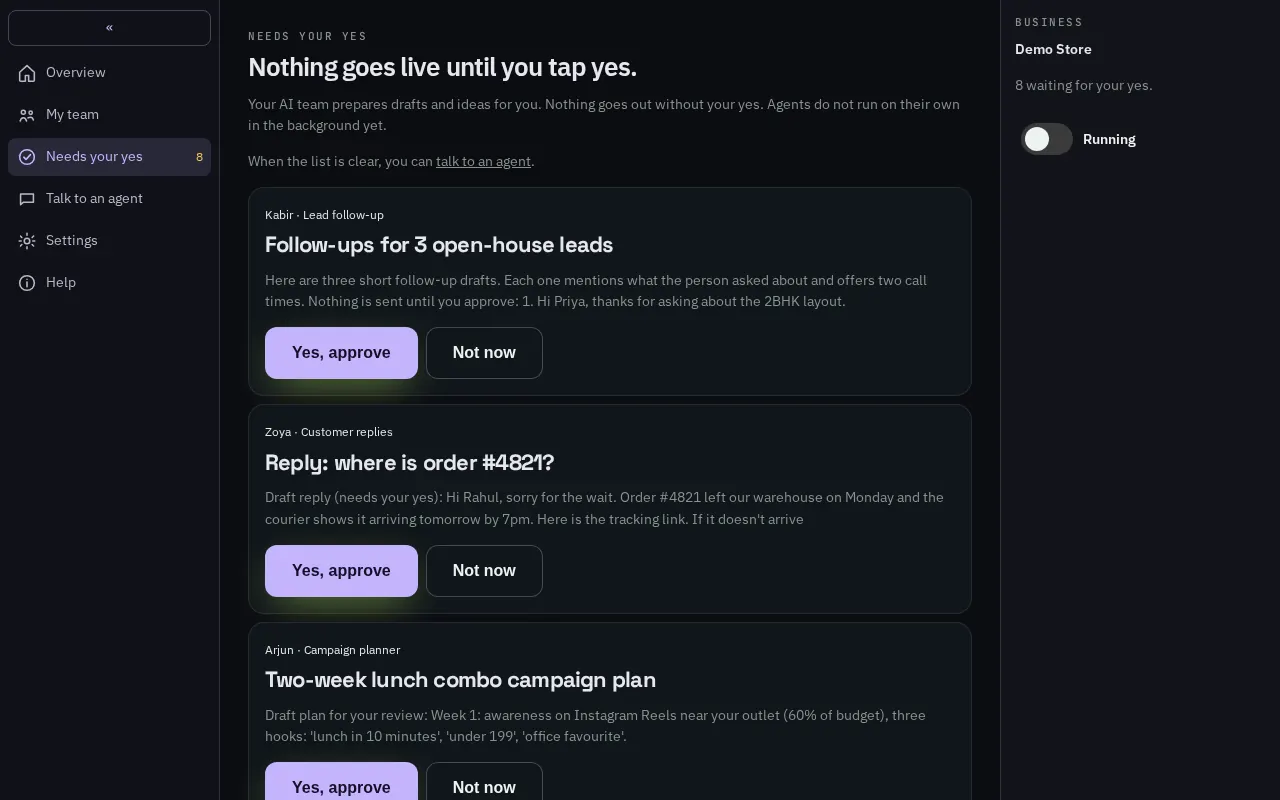
AI Time Machine is a set of 55 ready-made AI agents in 8 teams for small businesses. It is not a custom agent builder and does not connect to Expense tool on its own. The agents closest to this job draft work in their role, using the AI provider key you connect, and nothing goes out until you approve it:
- Anjali, Expense notes (Money): Turns a messy note into a clean expense line.
- Kavita, Numbers summary (Money): Puts this week's money into a few plain lines. Does not invent figures.
Frequently asked questions
Can AI audit 100 percent of expenses?
Yes, that is its main advantage over sampling, as long as flags are reviewed by people.
What does it catch?
Duplicates, missing receipts, out-of-policy spend, mismatched amounts and unusual patterns.
Does it reject claims automatically?
It should flag and explain; final decisions belong to finance or managers.
Can an AI agent prepare tax returns?
It can collect documents, categorise data and draft figures, but a qualified professional must review and sign off.
Can a small accounting firms business build an AI expense audit agent for accounting firms without developers?
Partly. No-code tools such as n8n, Dify or Langflow can connect a model to Practice management and email for a first version. Integrations with Accounting software, approvals and testing usually need some technical help.
Sources and further reading
- Building effective agents — Anthropic
- A practical guide to building agents — OpenAI
- AI Risk Management Framework — NIST
- OWASP Top 10 for LLM Applications — OWASP GenAI Security Project
- Retrieval-Augmented Generation for Knowledge-Intensive NLP Tasks — Lewis et al., arXiv 2005.11401
- Tool use with Claude — Anthropic
- AICPA & CIMA — AICPA & CIMA
- IFRS Standards — IFRS Foundation
- Internal Revenue Service — IRS
Need an AI expense audit agent for accounting firms? Tell us what you need
Tell us what you want the agent to do. We read every request and reply by email, usually within two business days, with an honest view of whether our ready-made agents fit or what a custom build would involve.
Or start today with 55 ready-made AI agents
AI Time Machine gives a small business 55 agents in 8 teams (sales, support, marketing, content, SEO, operations, money and a CEO office). They draft the work, you approve it, and they use the AI provider key you connect. One-time payment, no subscription.