Data & research agent
AI Data Analyst Agent: What It Is, How It Works and How to Build One
An AI data analyst agent answers business questions in plain language by writing and running SQL or Python against your data, building charts and explaining the results. It speeds up routine reporting and ad-hoc analysis, provided it works on governed, read-only data and shows its queries so people can verify the numbers.
What is an AI data analyst agent?
Analyst agents translate a question like 'why did sales drop last week?' into queries, run them, check the output, and write a short explanation with a chart. The key design choices are data access, a semantic layer that defines metrics, and verification.
In short: a person still owns the outcome. The agent does the repetitive reading, writing and lookups, and numbers used in board, investor or financial reporting are reviewed by an analyst.
What does an AI data analyst agent do?
Most teams start with two or three of these tasks and add more once the first ones are reliable:
- Translate questions into SQL or Python
- Run queries on a warehouse or spreadsheet
- Build charts and tables
- Explain trends, drivers and anomalies
- Schedule recurring reports and summaries
- Document metric definitions
How does an AI data analyst agent work?
Recommended architecture: single agent with tools. The model runs a loop: read the request, decide which tool to call, read the tool result, and repeat until it can answer or needs a person. This is the reason-and-act (ReAct) pattern most frameworks implement.
Why this pattern fits: requests vary a lot from one conversation to the next, so a fixed script would break. A tool loop lets the agent take a different path each time while the tools themselves stay narrow and safe. Anthropic's guide to agent design makes the same point: start with the simplest pattern that works and add autonomy only when it clearly helps (Anthropic: Building effective agents).
| Component | Role in this agent | Example options |
|---|---|---|
| Language model | Reads the request, decides the next step and writes drafts | GPT, Claude, Gemini, or open-weight models such as Llama, Qwen or Mistral via a gateway like LiteLLM |
| Tools | Actions the agent may take: Data warehouse, BI tool, Python sandbox, Spreadsheets | Function calling or Model Context Protocol (MCP) servers |
| Knowledge (RAG) | Retrieve table schemas, column descriptions and verified example queries. | A vector store such as Chroma or Qdrant, or your database's search |
| Memory | A library of verified queries and definitions the agent reuses. | CRM or database records; a memory layer such as Mem0 or Zep for longer histories |
| Orchestration | Single agent with tools | pydantic-ai or smolagents |
| Guardrails & approval | Numbers used in board, investor or financial reporting are reviewed by an analyst. | Approval queue, allow-listed actions, logging |
Data the agent needs
- Warehouse tables with descriptions
- Metric definitions
- Past reports
- Business calendar and events
What does an AI data analyst agent workflow look like?
A typical run, from trigger to a logged result:
- User asks a question in chat
- Agent looks up metric definitions and schemas
- Agent writes and runs a query in a sandbox
- Agent checks results for sanity and builds a chart
- Agent answers with the query attached
How do you build an AI data analyst agent, step by step?
- Define the scope. Pick two or three tasks to automate first (for example: translate questions into SQL or Python; run queries on a warehouse or spreadsheet). Write down what the agent must never do.
- Collect the knowledge. Gather warehouse tables with descriptions and metric definitions. Clean, current documents matter more than model choice.
- Choose the stack. Use the single agent with tools pattern. Free options include pydantic/pydantic-ai, huggingface/smolagents, langchain-ai/langgraph; pick one your team can maintain.
- Connect the tools. Give the agent narrow, least-privilege access to Data warehouse, BI tool, Python sandbox. Start read-only where you can.
- Write the instructions. Write a system prompt with the role, allowed sources, tone, limits and when to hand off. Keep examples of good outputs next to it.
- Add retrieval and memory. Retrieve table schemas, column descriptions and verified example queries. A library of verified queries and definitions the agent reuses.
- Add guardrails and approvals. Numbers used in board, investor or financial reporting are reviewed by an analyst. Log every tool call and output.
- Evaluate before launch. Build a test set of 50 questions with known answers and require a high pass rate before sharing widely.
- Launch small and monitor. Roll out to one team, channel or segment. Track answer accuracy and time to insight, review failures weekly and expand only when quality holds.
Answer using only the tables described. Show the SQL you ran, the row count, and one sentence on any caveat. If a metric is not defined, ask which definition to use.For model tool use, see the official guides on OpenAI: Function calling guide and Anthropic: Tool use with Claude. OpenAI's practical guide to building agents covers instructions, tools and guardrails in more depth.
Which free, open-source repos can you use to build an AI data analyst agent?
Each repository below was checked on GitHub on 2026-11-26. Licences differ, and some "fair-code" or source-available licences limit commercial hosting, so read the licence before you ship.
| Repository | What it is | Licence | Language |
|---|---|---|---|
| vanna-ai/vanna | Text-to-SQL library for asking questions of a database (repository archived; fine for learning, check for a maintained successor) | MIT | Python |
| pydantic/pydantic-ai | Typed Python agent framework with structured outputs | MIT | Python |
| huggingface/smolagents | Hugging Face's minimal library for agents that write and run code | Apache-2.0 | Python |
| langchain-ai/langgraph | Library for stateful, controllable agent graphs with human-in-the-loop support | MIT | Python |
| e2b-dev/E2B | Secure cloud sandboxes for running agent-generated code | Apache-2.0 | Python |
Which AI platforms offer AI data analyst agents?
If you would rather buy than build, these commercial products offer agents or features for this job. We list them for reference only; we are not affiliated with them, and features and pricing change, so check each vendor's site.
| Platform | Type |
|---|---|
| ThoughtSpot | AI analytics |
| Julius AI | AI data analysis |
| Glean | Enterprise search and work AI agents |
| Microsoft Copilot Studio | Low-code agent builder for Microsoft 365 |
Build, buy, or start with ready-made agents?
| Option | Effort | Cost model | Best for |
|---|---|---|---|
| Build with open source | High: engineering, hosting, evaluation | Free code; you pay for models and hosting | Teams with developers that need full control or custom integrations |
| Commercial agent platform | Medium: configuration and integration | Usually subscription or per-conversation pricing | Companies already on that vendor's suite |
| AI Time Machine (55 ready-made agents) | Low: sign in, connect your own AI key, choose agents | One-time payment | Small businesses that want drafts for everyday sales, support, marketing and admin work, approved by a person |
How do you measure an AI data analyst agent?
Measure outcomes, not activity. Set a baseline before launch so you can show the change:
| Metric | How to measure it |
|---|---|
| Answer accuracy | Answers that match analyst-verified results |
| Time to insight | Minutes from question to verified answer |
| Self-serve adoption | Questions answered without the data team |
| Query cost | Warehouse spend per question |
What are the risks of an AI data analyst agent, and how do you control them?
| Risk | Control |
|---|---|
| Confidently wrong numbers | Show the query, row counts and definitions with every answer |
| Data leakage | Use read-only roles and row-level security |
| Runaway query costs | Set limits on bytes scanned and timeouts |
General AI security risks such as prompt injection, data leakage and excessive agent permissions are catalogued in the OWASP GenAI Security Project: OWASP Top 10 for LLM Applications. For governance, the NIST: AI Risk Management Framework is a widely used framework.
Can AI Time Machine help with data & research work?
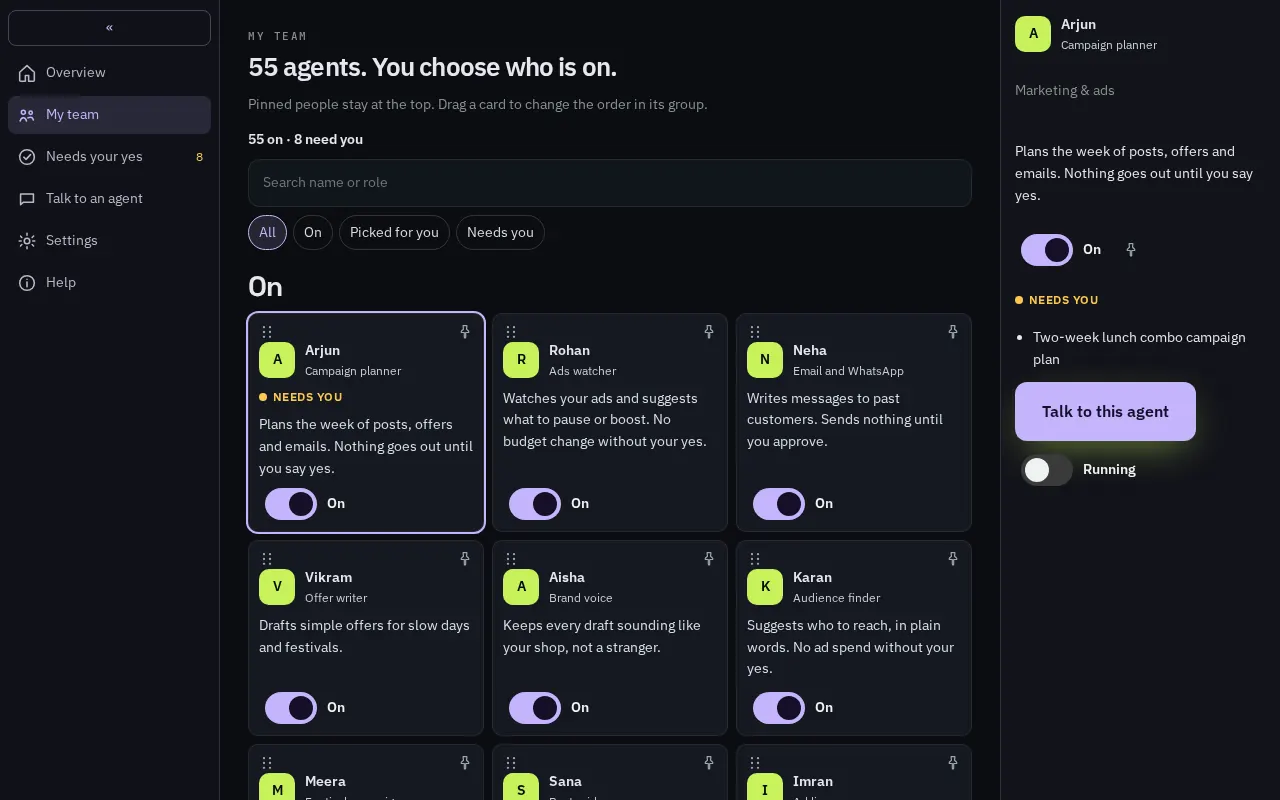
AI Time Machine is a set of 55 ready-made AI agents in 8 teams for small businesses. It is not a custom agent builder and does not connect to Data warehouse on its own. The agents closest to this job draft work in their role, using the AI provider key you connect, and nothing goes out until you approve it:
- Kavita, Numbers summary (Money): Puts this week's money into a few plain lines. Does not invent figures.
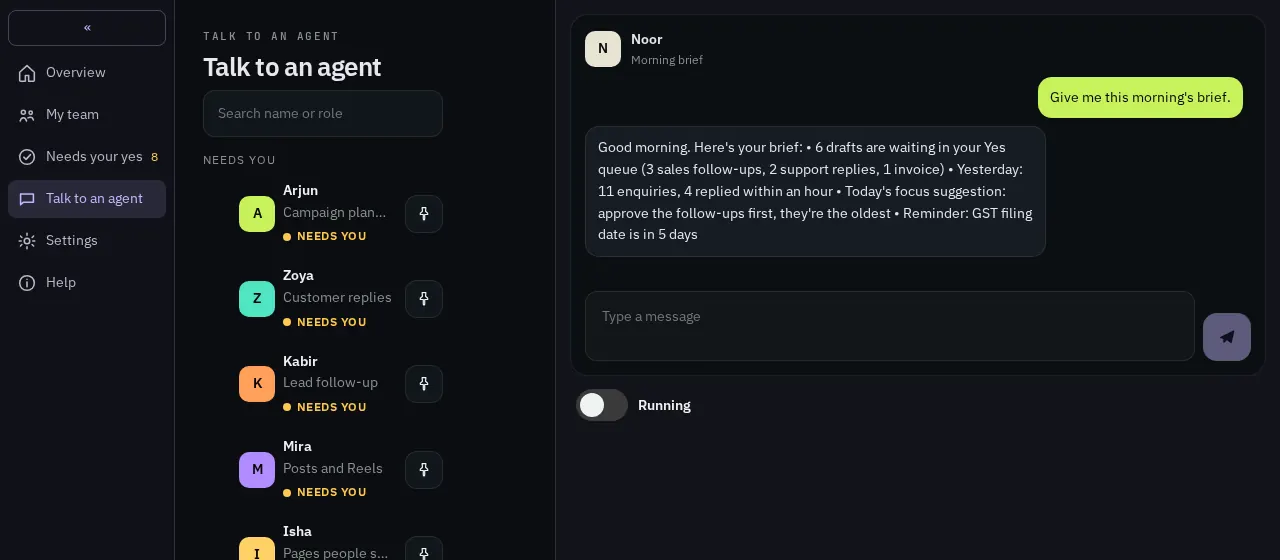
- Noor, Morning brief (CEO office): A short good morning: what needs your yes, and what can wait.
- Ayaan, AI CEO (CEO office): Picks your starting team and brings you one note. Decides nothing without you.
Frequently asked questions
Can AI replace a data analyst?
It handles routine questions and first drafts; analysts still define metrics, check logic and frame decisions.
How do I stop it giving wrong numbers?
Use a semantic layer, show queries, test on known answers and restrict it to governed tables.
Does it work with Excel and Google Sheets?
Yes, many agents can read spreadsheets or run Python on uploaded files.
Is my data safe?
Use read-only credentials, keep data in your environment where possible and review the provider's data policies.
Do I need to code to build an AI data analyst agent?
Not for a first version. Visual tools such as n8n, Dify, Flowise or Langflow can connect a model, your documents and Data warehouse. Production systems with approvals, logging and evaluation usually need a developer.
How much does it cost to run an AI data analyst agent?
Costs come from model usage (priced per token), hosting, and any paid tools or APIs. Routing simple steps to smaller models and caching retrieved documents keeps costs down. Measure cost per completed task, not per message.
Sources and further reading
- Building effective agents — Anthropic
- A practical guide to building agents — OpenAI
- ReAct: Synergizing Reasoning and Acting in Language Models — Yao et al., arXiv 2210.03629
- AI Risk Management Framework — NIST
- OWASP Top 10 for LLM Applications — OWASP GenAI Security Project
- Function calling guide — OpenAI
- Retrieval-Augmented Generation for Knowledge-Intensive NLP Tasks — Lewis et al., arXiv 2005.11401
- Model Context Protocol — modelcontextprotocol.io
Need an AI data analyst agent? Tell us what you need
Tell us what you want the agent to do. We read every request and reply by email, usually within two business days, with an honest view of whether our ready-made agents fit or what a custom build would involve.
Or start today with 55 ready-made AI agents
AI Time Machine gives a small business 55 agents in 8 teams (sales, support, marketing, content, SEO, operations, money and a CEO office). They draft the work, you approve it, and they use the AI provider key you connect. One-time payment, no subscription.