Content agent · Education
AI Content Writing Agent for Education
An AI content writing agent for education is a language-model agent that researches, drafts and edits articles and copy with sources for schools, colleges, coaching institutes and edtech companies. It works in tools such as Web search and scraping and Student information system, follows written rules for education, and leaves money, terms and personal data decisions to a person.
What is an AI content writing agent for education?
Education providers handle admissions enquiries, timetables, fee questions and learning support, with peaks around enrolment and exams. An AI content writing agent for education applies the AI content writing agent idea to that setting: content agents chain steps: research, outline, draft, critique and revise. Splitting the work this way produces better results than asking one prompt for a finished article.
For schools, colleges, coaching institutes and edtech companies, the people on the other side are students and parents. The agent has to speak their language, respect the rules of the sector and work inside the systems the team already uses rather than adding another dashboard.
What does an AI content writing agent for education do?
Its core job in education: it researches, drafts and edits articles and copy with sources. A common content task for schools, colleges, coaching institutes and edtech companies: the agent creates practice questions, summaries and lesson materials from approved sources for teacher review. For example: From a chapter on photosynthesis, the agent drafts ten practice questions with answers for the teacher to check.
Tasks it can take on for schools, colleges, coaching institutes and edtech companies
- Research a topic and collect sources
- Create outlines that match search intent
- Draft articles, emails and product descriptions
- Rewrite for tone, length and reading level
- Check facts and add citations
- Repurpose long content into short formats
Day-to-day pressures in education
- Admissions teams overwhelmed in peak season
- Repeated questions about fees and timetables
- Teachers short of time for feedback
- Students drop off without anyone noticing
How does an AI content writing agent for education work?
Recommended architecture: fixed pipeline (prompt chaining). Work moves through ordered steps, each with its own narrow prompt and a check between steps: for example extract, validate, draft, review. If a check fails, the item stops and goes to a person.
Why this pattern fits: the task has a known shape. Splitting it into steps makes each step more accurate and lets you test and improve them one at a time. Anthropic's guide to agent design makes the same point: start with the simplest pattern that works and add autonomy only when it clearly helps (Anthropic: Building effective agents).
| Component | Role in this agent | Example options |
|---|---|---|
| Language model | Reads the request, decides the next step and writes drafts | GPT, Claude, Gemini, or open-weight models such as Llama, Qwen or Mistral via a gateway like LiteLLM |
| Tools | Actions the agent may take: Web search and scraping, CMS, Docs, Grammar and plagiarism checker | Function calling or Model Context Protocol (MCP) servers |
| Industry systems | Where customer records and day-to-day work items live | Student information system, Learning management system, Admissions CRM |
| Knowledge (RAG) | Retrieve source documents and past articles for facts and internal-link candidates. | A vector store such as Chroma or Qdrant, or your database's search |
| Memory | Style guide and list of published articles so the agent avoids repeating angles and adds internal links. | CRM or database records; a memory layer such as Mem0 or Zep for longer histories |
| Orchestration | Fixed pipeline (prompt chaining) | crewAI or langgraph |
| Guardrails & approval | An editor reviews every piece before publishing, especially claims, numbers and quotes. | Approval queue, allow-listed actions, logging |
Data the agent needs
- Course catalogue, fees and schedules
- Admissions criteria and deadlines
- Policies and student handbook
- Approved learning materials
- Style guide
- Approved product facts
What does an AI content writing agent for education workflow look like?
A typical run, from trigger to a logged result in education:
- Brief with audience, intent and sources
- Research and outline step
- Draft step in brand voice
- Critique step checks facts, structure and style
- Editor reviews and publishes
How do you build an AI content writing agent for education, step by step?
- Define the scope. Pick two or three tasks to automate first (for example: research a topic and collect sources; create outlines that match search intent). Write down what the agent must never do.
- Collect the knowledge. Gather course catalogue, fees and schedules and admissions criteria and deadlines. Clean, current documents matter more than model choice.
- Choose the stack. Use the fixed pipeline (prompt chaining) pattern. Free options include crewAIInc/crewAI, langchain-ai/langgraph, stanfordnlp/dspy; pick one your team can maintain.
- Connect the tools. Give the agent narrow, least-privilege access to Web search and scraping, CMS, Docs and Student information system. Start read-only where you can.
- Write the instructions. Write a system prompt with the role, allowed sources, tone, limits and when to hand off. Keep examples of good outputs next to it.
- Add retrieval and memory. Retrieve source documents and past articles for facts and internal-link candidates. Style guide and list of published articles so the agent avoids repeating angles and adds internal links.
- Add guardrails and approvals. An editor reviews every piece before publishing, especially claims, numbers and quotes. Log every tool call and output.
- Evaluate before launch. Have editors score ten drafts on accuracy, structure and voice against a checklist before using the agent in production.
- Launch small and monitor. Roll out to one team, channel or segment. Track time to first draft and edit distance, review failures weekly and expand only when quality holds.
Draft a 1,200-word article for {audience} on {topic}. Use only facts from the attached sources and cite them inline. Include a short summary at the top and three FAQs. Flag any claim you could not verify.For model tool use, see the official guides on OpenAI: Function calling guide and Anthropic: Tool use with Claude. OpenAI's practical guide to building agents covers instructions, tools and guardrails in more depth.
Which free, open-source repos can you use to build an AI content writing agent for education?
Each repository below was checked on GitHub on 2026-11-26. Licences differ, and some "fair-code" or source-available licences limit commercial hosting, so read the licence before you ship.
| Repository | What it is | Licence | Language |
|---|---|---|---|
| crewAIInc/crewAI | Python framework for role-based multi-agent crews | MIT | Python |
| langchain-ai/langgraph | Library for stateful, controllable agent graphs with human-in-the-loop support | MIT | Python |
| stanfordnlp/dspy | Framework for programming and optimising LM pipelines instead of hand-writing prompts | MIT | Python |
| run-llama/llama_index | Framework for document ingestion, indexing and retrieval agents | MIT | Python |
| unclecode/crawl4ai | Open-source web crawler that outputs LLM-ready text | Apache-2.0 | Python |
Which AI platforms offer AI content writing agents?
If you would rather buy than build, these commercial products offer agents or features for this job. We list them for reference only; we are not affiliated with them, and features and pricing change, so check each vendor's site.
| Platform | Type |
|---|---|
| Jasper | AI marketing content platform |
| Writer | Enterprise generative AI and agents |
| Notion AI | Workspace AI and agents |
| Surfer | SEO content optimisation |
Build, buy, or start with ready-made agents?
| Option | Effort | Cost model | Best for |
|---|---|---|---|
| Build with open source | High: engineering, hosting, evaluation | Free code; you pay for models and hosting | Teams with developers that need full control or custom integrations |
| Commercial agent platform | Medium: configuration and integration | Usually subscription or per-conversation pricing | Companies already on that vendor's suite |
| AI Time Machine (55 ready-made agents) | Low: sign in, connect your own AI key, choose agents | One-time payment | Small businesses that want drafts for everyday sales, support, marketing and admin work, approved by a person |
How do you measure an AI content writing agent for education?
Measure outcomes, not activity. Set a baseline before launch so you can show the change:
| Metric | How to measure it |
|---|---|
| Time to first draft | Hours from brief to editable draft |
| Edit distance | How much editors change; falling means better drafts |
| Factual error rate | Errors found per article in review |
| Enquiry-to-enrolment rate | Admissions enquiries that enrol |
| Student query response time | Hours to answer student and parent questions |
What are the risks of an AI content writing agent for education, and how do you control them?
| Risk | Control |
|---|---|
| Fabricated facts or quotes | Require a source for each claim and verify before publishing |
| Plagiarism | Run originality checks and avoid copying competitor text |
| Same-sounding content | Feed real examples, data and expert input into each piece |
Rules and standards to check in education
- FERPA and student privacy rules for education records (U.S. Department of Education)
- UNESCO guidance on AI in education (UNESCO)
- Child data protection and parental consent rules (gdpr-info.eu)
This is general information, not legal advice. Requirements depend on your country, state and use case.
General AI security risks such as prompt injection, data leakage and excessive agent permissions are catalogued in the OWASP GenAI Security Project: OWASP Top 10 for LLM Applications. For governance, the NIST: AI Risk Management Framework is a widely used framework.
Can AI Time Machine help with content work in education?
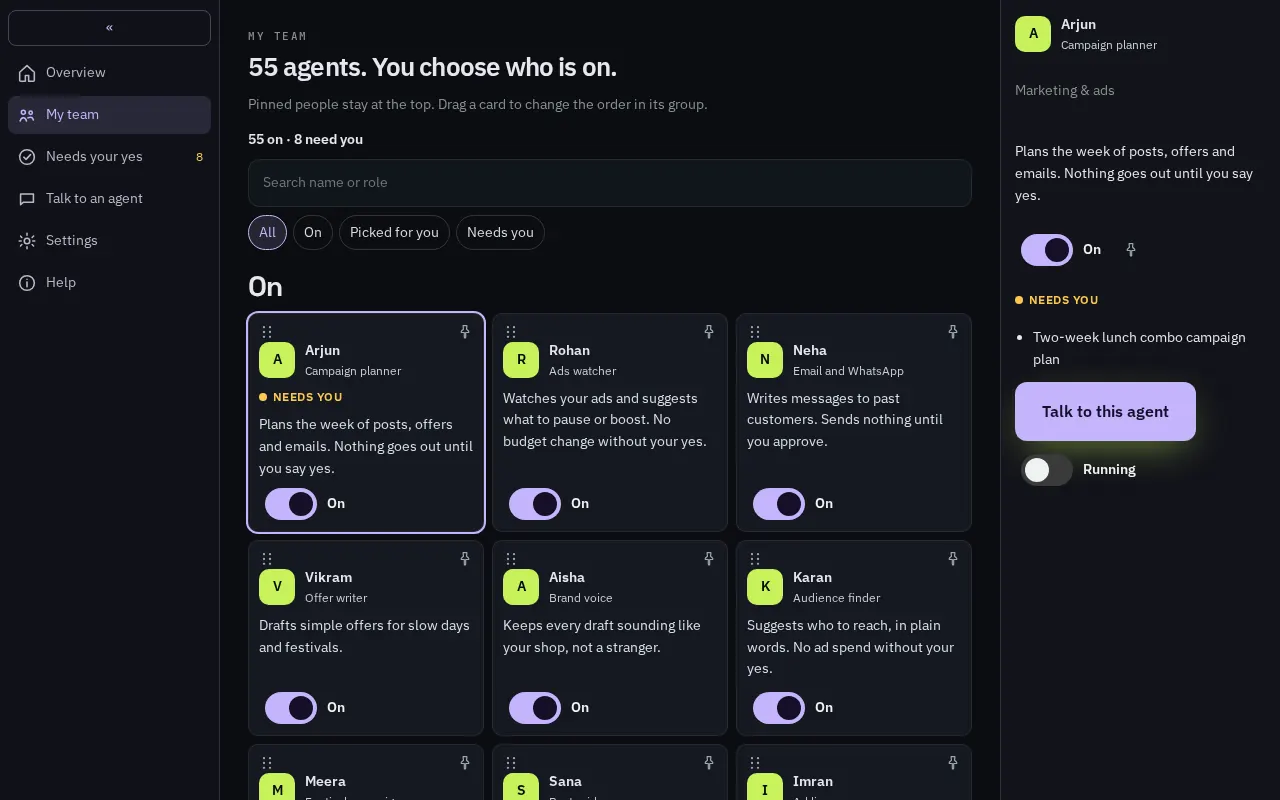
AI Time Machine is a set of 55 ready-made AI agents in 8 teams for small businesses. It is not a custom agent builder and does not connect to Web search and scraping on its own. The agents closest to this job draft work in their role, using the AI provider key you connect, and nothing goes out until you approve it:
- Varun, Page drafts (Content): Writes a simple page about what you sell.
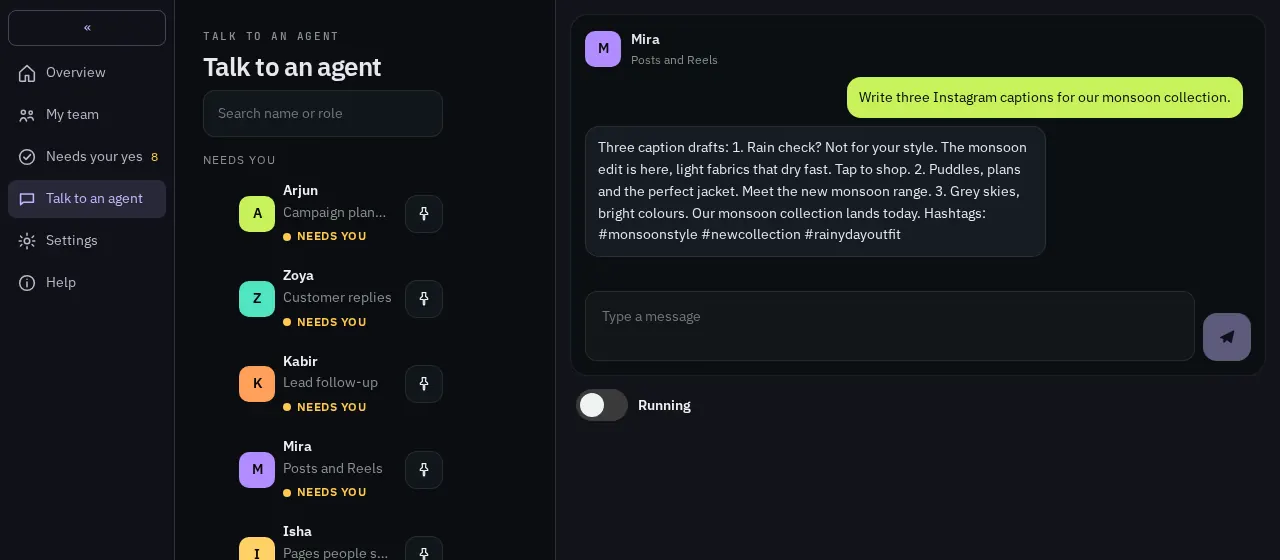
- Mira, Posts and Reels (Content): Drafts posts and Reel ideas in your voice. Posts nothing until you say yes.
- Rhea, Captions (Content): Writes the words under a photo.
- Sara, Customer broadcasts (Content): Drafts one message for past customers.
- Myra, Google posts (Content): Drafts a short post for your Google listing.
Frequently asked questions
Is AI-written content good enough to publish?
Drafts can be good, but publishing without editing risks factual errors and generic writing. Treat the agent as a fast first-draft writer.
How do I keep the brand voice?
Provide a style guide and several annotated examples, and use a critique step that checks against them.
Can it write in other languages?
Yes, but have a native speaker review important content.
Is it safe to use AI agents with students?
Yes with care: limit personal data, follow student privacy law, keep teachers in charge of assessment, and use age-appropriate content controls.
Can a small education business build an AI content writing agent for education without developers?
Partly. No-code tools such as n8n, Dify or Langflow can connect a model to Student information system and email for a first version. Integrations with Learning management system, approvals and testing usually need some technical help.
Sources and further reading
- Building effective agents — Anthropic
- A practical guide to building agents — OpenAI
- AI Risk Management Framework — NIST
- OWASP Top 10 for LLM Applications — OWASP GenAI Security Project
- Retrieval-Augmented Generation for Knowledge-Intensive NLP Tasks — Lewis et al., arXiv 2005.11401
- Model Context Protocol — modelcontextprotocol.io
- FERPA — U.S. Department of Education
- Artificial intelligence in education — UNESCO
- General Data Protection Regulation (text) — gdpr-info.eu
Need an AI content writing agent for education? Tell us what you need
Tell us what you want the agent to do. We read every request and reply by email, usually within two business days, with an honest view of whether our ready-made agents fit or what a custom build would involve.
Or start today with 55 ready-made AI agents
AI Time Machine gives a small business 55 agents in 8 teams (sales, support, marketing, content, SEO, operations, money and a CEO office). They draft the work, you approve it, and they use the AI provider key you connect. One-time payment, no subscription.